
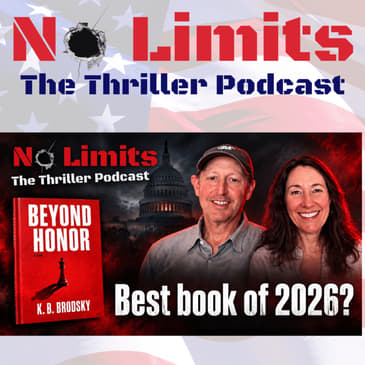
K.B. Brodsky return to No Limits: The Thriller Podcast on their publication day for a spoiler-free discussion of Beyond Honor, an emotionally rich, high-stakes spy thriller that may be one of the best books of 2026.
Karen and Bill Brodsky, who write together as K.B. Brodsky, take us inside the creation of Beyond Honor—from the tensions and rewards of co-writing as a husband-and-wife team to building a novel that combines espionage, suspense, and genuine emotional weight.
In this conversation, we discuss:
How Karen and Bill co-write fiction as a married couple—and how two creative voices become one cohesive novel
The process of developing Beyond Honor as a propulsive spy thriller
Why character emotion matters just as much as plot, tradecraft, and international intrigue
The characters’ journeys, personal stakes, relationships, and arcs—without revealing key plot developments
What makes espionage fiction endure and why a great spy novel needs readers to care deeply about the people at its center
Why Beyond Honor is a standout thriller read for 2026
If you enjoy intelligent spy novels, espionage thrillers, morally complex characters, and stories where the emotional consequences of danger matter as much as the action, this interview is for you.
—
🔗 WATCH, LISTEN, & FOLLOW US:
Website → https://thrillerpod.com
YouTube → https://thrillerpod.com/youtube
Spotify → https://thrillerpod.com/spotify
Apple Podcasts → https://www.thrillerpod.com/apple
Instagram → https://thrillerpod.com/instagram
Twitter/X → https://thrillerpod.com/twitter
Facebook → https://thrillerpod.com/facebook
💬 JOIN OUR BOOK CLUB
Die-hard thriller fan? Join our Book Club on Patreon for exclusive discussions, behind-the-scenes insights, and 24/7 thriller conversation:
👉 https://thrillerpod.com/bookclub
📚 ABOUT NO LIMITS:
• The Mitch Rapp Podcast: Deep dives into Vince Flynn & Kyle Mills' Mitch Rapp series.
• The Scot Harvath Podcast: Exploring Brad Thor's high-octane Scot Harvath universe.
• The Thriller Podcast: Book reviews across the thriller genre: Jack Carr, Dan Brown, and more!
—
#KBBrodsky #BeyondHonor #ThrillerPod #ThrillerBookReview
[00:00:10] All right, guys, today we are joined again with Karen and Bill Brodsky, the genius partnership behind Beyond Honor, which comes out today. So I have to ask, what are you doing online with me? You should be popping a cork and celebrating. We got our good scotch here. We're enjoying. We're so happy to be with you. This is where we want to be today.
[00:00:35] That's right. Yeah. Thanks for coming on with Chris a few weeks ago. It's a bummer. I couldn't make it, but I'm glad we get to fill in the gaps here. And I just have to start buzzkill. I'm being a buzzkill for your pub day. And Karen, I identified with that because friends and family and now all of our podcast listeners know me as the one who just can tank a book, tank a movie, complain about something, point out inconsistencies. I have to say, I can't do that at all with your book. Oh, nice. Thanks.
[00:01:05] Let me just say, so I've been loving listening to your podcast over the last couple of months. And that's a huge compliment. So thanks for saying that. Yeah. Hey, thank you. I thought you were saying you were giving him a huge compliment. No, I think it was. I take it as a compliment. So thank you. Yeah, no, we put a lot of work into this. And as you guys know and the listeners know, we like to include spoilers. So if we could save a little time at the end, I'd like to ask you some more specific targeted questions about the characters and moves and the plot in the book.
[00:01:35] Yeah. But for now, we'll keep it spoiler free. So everyone, we're spoiler free. Pick up your copy out today as of recording September 1st and eventually come back. We'll have another treat for you, a bonus episode with some spoiler content when you finish. But first, let me just ask, I think what carries a thriller novel is the characters and their relationships. We don't always need the whiz bang, the world ending, nuke on the loose plot, a biological attack, all these things.
[00:02:02] I think they distract from what really is the core of a story, and that's the characters. How did you make some of the most memorable characters we'll ever read in Kevin Rhodes, Skylar, and my personal favorite, Cynthia King? Tell us a little bit about them. Yes. Ours too, actually. Well, thanks for saying that. That's super nice. And I think when we thought about this book, and we talked about this last time we were on your podcast,
[00:02:29] we were really inspired by those old school Tom Clancy, Ken Follett, you know, those kinds of, even the really at the beginning, the Vince Flynn books that really pumped the brakes a little bit and spent a little more time trying to like, you know, set the table.
[00:02:56] So there could be a character arc that's more meaningful than, you know, just an action book. And I would like to say, you know, I love the Mark Rainey books, and I love the Jack Carr books. And, you know, and I love the Wilson and the other guy who writes those books. So I'm not suggesting that this is just a little different kind of book. I think it's a little more of a retro, you know, to some of those old school novels.
[00:03:27] Yeah, I think I'll definitely agree. And we've commented on the pod, all the Thors that we read, Vince Flynn, you know, we're suckers for those series. That's how I got started with the pod and really got started into reading was those guys with my generation growing up. But I do notice something lacking when I do go back and grab a Clancy or a Le Corée. I'm seeing a bit of a deeper draw into the human psyche and the manipulation of people, not through force and power, but through true spy craft.
[00:03:55] And I feel like something we miss in these more pop reads that have this, like I said before, whiz bang and shoot them up style. I think we're missing a little bit of that deeper element. And you guys got it here. So what was it like crafting a true spy story? And not to mention, you even touch on some Cold War stuff. You have some flashbacks. Yeah, which is really right. And that was really fun writing because you're we're mostly in. Is that okay if I talk?
[00:04:23] Yeah, we're mostly in a modern setting. And then we pull back to Berlin in the 80s. All of a sudden, it's, you know, she's reaching for her microphone that's taped to her vest. And she's pumping the clutch on the old Landa.
[00:04:42] You know, and I thought that was, you know, super fun just to, you know, from if you're reading it, all of a sudden you're just like transported to a different time and transported to a different set of technology that keeps you in that time. And I just thought that was a fun little moment. My sister immediately texted and she's like, you know, there's a prequel you have to write, don't you? She's like, you know, we need that story. I was like, oh, that's good. I'll do that.
[00:05:13] I wouldn't mind some more Cynthia King. And I just like to really briefly jump back. Exactly. She's so fun. She's so fun. And that's what I was going to say is like, I think because we both love, like love these characters so much. I mean, we lose a couple of characters and I literally would cry. Like he'd walk in the room and I'll be crying and I'll be, he's like, you know, not sobbing, but just like what's going on? I'm like, it just happened again. You know, like, and, and so like we, we care so much about the characters.
[00:05:41] They're so real to us that I think that's part of maybe what you see is that we, we love these guys. But I think getting back to your original question. So when we thought about this book, we thought about a theme that was to carry the story. And the theme was, and we talked about this a little bit with the last time when we talked with Chris, we, we talked about that. This is a, this is a book about honor and betrayal.
[00:06:11] And so all of our characters are going through some type of arc of honor, something that they believe in something that they feel strongly about. And then something happens where they're making decisions that are honorable in, in, in essence, but it pushes them beyond honor. If I, if I could say has, but, but, but, and so then they're forced to make some decisions.
[00:06:39] And I, and it's not just, you know, our, our, our, our hero or one of our heroes who is, you know, he's like, Hey, he's pushed to the limit. He's got to, he's got to deal with revenge. Revenge.
[00:06:50] It's Whitney feeling as though like, no, well, which I'm not going to spoil it, but, but it's like Whitney saying like, I'm like, you know, I'm, I'm, I'm, I'm faced with a decision where I could, you know, go with my, um, go with my, um, my responsibility for my job or my responsibility to my relationship.
[00:07:13] It's Cynthia King using her debt of honor against Summers who, you know, feels like she can't, um, say no because of what happened in the past. And I think, so these are very similar themes that create the arcs for the character. Yeah. And some of those arcs are just absolutely heart wrenching.
[00:07:37] In fact, I know Karen, you mentioned the loss of some characters, even some of the bigger losses that are sitting with me having closed the book are the people who are still alive. They, they also have dealt with almost a loss of part of their humanity. And that, and that goes into the beyond honor of it all. And a quote that kept coming back to me about the book, it's a, I'm probably going to butcher it. It's a William Faulkner quote. The only story worth telling is the human heart in conflict with itself.
[00:08:06] And some of the things that your characters go through, Skylar, Kevin, I'm almost concerned for them. Like as much as you created them. So I can imagine they're like your baby. I just, as a reader who spent a few hours with them on page, they're, they're in my mind. They're like affecting the decisions I make. I'm thinking about what they did, what I would do in their shoes. So I think you, you get this sense of realism that Bill, as we were talking about, maybe is lost in some of the pop fiction of today. People are focused on the realism of the technical aspects.
[00:08:36] Got to get the guns right, which I think you guys largely do. I wouldn't know, but it looks like you put in your research there, but almost more important to make the story real is do the characters have feelings and emotions that we would have? And are they put in the most stressful circumstances that we can never imagine being in? And we get to watch what they do and makes us wonder what we would do. Do you think those moral dilemmas were part of your writing naturally or did you intend to put the characters in those situations? It was intentional. Yeah.
[00:09:04] That was part, I mean, like we said, like that was part of what we wanted was to sort of, because you can also look at like, you know, some of the less admirable characters in the book. Peter Michaels, President Kemp. Like, they also butt up against this opportunity to struggle with honor and they, you know, they cave pretty fast. And so we wanted that sort of idea of playing all these different characters off. Everybody, what does that feel like? That was, yeah, it was very intentional.
[00:09:34] And I think when you read a Le Carre book, particularly, who deals in the subtleties of human behavior and human emotion, I think if you could get through those books, which are, you know, some of them are pretty hard to get through because they're so well crafted and so dense that you do relate to the characters. And I think to your point that you, it becomes a little personal. You're like, oh, I know that feeling.
[00:10:01] I've been in not that situation, but it's like something that mirrors the situation and it brings you into the story. So you want to keep on reading. And I think that is something that we were, we wanted to make the stakes very believable. That nothing happens in the book that you were saying like, that's stupid. That could never happen. There's no superheroes. Right.
[00:10:25] And so, and the great big problem in the book or the big thing in the book is also something that's, to your point, it's not, you know, that the tides are going to engulf a city or, you know, there's a, there's a, you know, some gigantic catastrophe that's going to be, you know, global. That these are stakes that we can understand.
[00:10:48] And I think that makes the book or makes any story like that really, which is Lecrae, Lecrae is so good at, or Clancy, but some of those books anyway, that you really makes it very personal for the reader.
[00:11:27] Oh, for sure. And you're doing it with such precision. Do you think that maybe was born out of the co-authoring? Was that something in the editing process? Because I know, Bill, you had written down the book. It sounds like, you know, kind of before family even knew about it. But then maybe, Karen, did you bring that more critical eye of needing to conserve or edit or whittle things down? How did that process go? Because it felt very, very precise where you ended up. I think the answer is yes, largely, but not entirely.
[00:11:56] I think certainly I am definitely more of like the one to like cut, cut, cut, cut, cut. What's the one word we can use instead of five? Or how can you use dialogue to take, you know, four page description and how can we get that into a conversation? And therefore, you're getting to know your characters more through the conversation and you're getting the information. Like that's sort of something that I really love working on, really enjoyed working into it.
[00:12:23] But I would also say because it was a collaboration and because I'm buzzkill, we had to like talk through a lot of these things. So there would be like, you know, something that maybe we didn't agree on. And because we kept talking about it, because we kept talking about it, we would come to a conclusion or consensus. Eventually, it had to always be a consensus.
[00:12:45] And I think that made it better because because you had this other person that was kind of pushing you and pushing you and pushing you and wasn't going to let it go because we both cared so deeply. And I really, really feel like that was a great process. I think it was Hemingway or someone in that generation said, if I had more time, it would have been shorter.
[00:13:05] You know, so I think we did spend time like, you know, every time we went through the manuscript, we cut a word or cut another word or cut another word and try to really, you know, get to the essence. Yeah. What's the one word? Yeah. Yeah. Yeah. That's really important to hear. It kind of makes me in spoilers want to ask maybe specifically about a few scenes of scenes that were made better through that process where you specifically gave each other.
[00:13:33] You know, when two people are going back and forth. We're so dying to talk about the actual book. Yeah. Well, let's make this that space. We're so excited to like do some of our book. Sure. Yeah. Let's make it that space. Just a few more to keep the people interested in what their whistles who have not yet ordered the book. Putin shows up here. So we're saying it doesn't have these kind of really world ending stakes. Yet we're also in the thick of Ukraine. And it's believable why we're brought there.
[00:14:03] To the front lines. We're in Syria, in Damascus, on the streets, staking out a high level terrorist who's connected to, you know, GWAT and the global war on terrorism. So there are these high level back end things. You almost balance perfectly the human emotional drama, which makes the book absolutely sing. And somehow you still have world global geopolitics as almost the vehicle to carry these characters forward. It was a perfect balance. How did that end up working with Syria and Ukraine? What made you go in that direction?
[00:14:37] Well, to answer your question, I think the without getting into spoilers. Whitney provided a great vehicle for a great arc where at the beginning of the book, she's less capable. She's growing into her own. And then the the I don't want to give you know, if we're not doing about spoilers, but in the second big move that she does, it was very obvious.
[00:15:07] Well, it was very what happened in the first thing that happened made her do the second thing that happened. And so while there's action, the action serves the character's arc or that's what we intended anyway. And so all those little moves, whether it was in Syria or Ukraine. Well, you know, it could have been, you know, Iraq and Afghanistan.
[00:15:32] Like, you know, those places were were vehicles for for just to show off Rhodes's skill, to show off his dilemma, to show Whitney's rise through the you know, through the through those different. Action scenes, but we're really. Showing her arc. Right. Yeah, that was that was the intention of making those moves. Yeah. And that makes sense, by the way.
[00:16:02] I don't know if you just if I could just go on. So Jason Matthews in the Red Sparrow series, he brought in and I think that the book and I hope in some way is some reflection of those three books that that trilogy that he wrote, then he unfortunately passed away. Because I thought those were really well written, terrific books. But Putin plays a big role in the Jason Matthews series.
[00:16:26] And in one point, he actually is having, you know, sleeping with the Red Sparrow, which is like he really brings him into the book. And so obviously we didn't go that far. But but that was an inspiration for that part of it. Yeah. And I think also maybe two point two is that you setting these things, even though Kemp is fictitional, like then you have a real Putin.
[00:16:50] And it does sort of help create that balance of you feel like you're in the real world and you feel like real things are happening. And it is also kind of interesting. Like I found that whole Ukraine part and working on that so fascinating because you do have to learn a lot about it when you when you're actually going to put it on paper. And the characters that are involved in the Ukraine scenes are so they're obviously fictitional individuals.
[00:17:15] But it does create a sense of like real stakes in the story and real stakes that are brought in from the real world, which I thought was enjoyable. Yeah, I think both of those are great points. And I just feel like you're doing something different because I've read a couple of Ukraine thrillers or scenes in a thriller. Even Brad Thorne did a whole book going into it. And then other authors, particularly towards the tail end of the Mitch Rapp series. Kyle Mills was often such that big brain genius.
[00:17:45] He would look at world events and be like, I'm putting that in a book. And so you guys almost did the reverse of you wanted it to be character centric and character forward. And our real world only is a touch point to access their life where I feel like a lot of authors, they take some storyline ripped from the headlines and they intentionally fit their characters into it. And that feels a little abrasive at times. Yours was frictionless. I mean, I can't think of a time I buzz killed and Karen, I'm with you. That's usually me. I went.
[00:18:15] I don't have a critique of the story. I was never taken out of it. I never rolled my eyes. I never said no way. I each and every time I was as invested as the characters were in what was going on and accomplishing the mission and mission accomplished of pushing out just a fantastic piece of literature. Oh, thank you so much. That is incredibly nice to hear. Thank you so much. Wow. I think maybe we should reserve a lot of our time because it's it's publication day. Let's talk spoilers.
[00:18:43] Let's talk about the book before we do. And we'll transition you guys to another episode. One other thing to wet your whistle. Every guest on No Limits gets a limerick. And for yours, like the quality of your writing, I wrote it a little bit more cryptic, a little deeper. So here's a little limerick to hopefully force people to go out there and buy this book. What happens to souls beyond honor? A dance with the devil improper. Spies telling lies. The White House the prize.
[00:19:12] Can hearts torn apart grow fonder? Nice. Wow. Look at you, man. And I know people listening to this segment might not have read book one, but that ending, will hearts torn apart grow fonder? You guys have a vision for book two and three. I heard two is written. Three is in the works. Oh, yeah. You left us at a place where I don't. He's up to something, but I don't know what. So I'll leave it at that. Nice. Nice. Yeah. Great limerick. That is so good. Great limerick. Thank you.
[00:19:42] Thank you.