
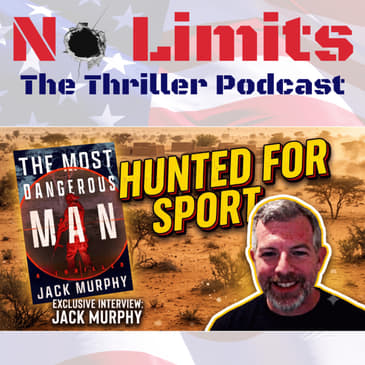
Army Ranger and Green Beret Jack Murphy joins us to discuss his explosive new military thriller, The Most Dangerous Man. We dive into the inspiration behind Staff Sgt. Jeremy Lopez’s fight for survival when he becomes the ultimate prey in a deadly game of billionaire hunters, the real-world tactics that make this book so authentic, and what it’s like to write a modern “Most Dangerous Game” with a Special Forces twist. No spoilers — just a conversation about craft, combat, and what makes a hunter truly dangerous.
—
🔗 WATCH, LISTEN, & FOLLOW US:
Website → https://thrillerpod.com
YouTube → https://thrillerpod.com/youtube
Spotify → https://thrillerpod.com/spotify
Apple Podcasts → https://www.thrillerpod.com/apple
Instagram → https://thrillerpod.com/instagram
Twitter/X → https://thrillerpod.com/twitter
Facebook → https://thrillerpod.com/facebook
💬 JOIN OUR BOOK CLUB
Die-hard thriller fan? Join our Book Club on Patreon for exclusive discussions, behind-the-scenes insights, and 24/7 thriller conversation:
👉 https://thrillerpod.com/bookclub
📚 ABOUT NO LIMITS:
• The Mitch Rapp Podcast: Deep dives into Vince Flynn & Kyle Mills' Mitch Rapp series.
• The Scot Harvath Podcast: Exploring Brad Thor's high-octane Scot Harvath universe.
• The Thriller Podcast: Book reviews across the thriller genre: Jack Carr, Dan Brown, and more!
—
#JackMurphy #TheMostDangerousMan #ThrillerPod #ThrillerBookReview #MilitaryThriller
[00:00:12] Today, guys, we are joined by a special guest. He might just be the most dangerous man, but that is the title of his book, his latest release from just last week. So Jack Murphy, welcome to the podcast and tell us how publication went. Jack Murphy Yeah, thanks for having me, guys. The book came out, went, you know, great. I think the reception, the early reception from readers has been really good. And I've been kind of doing the rounds on podcasts talking about the book, which seems to be the modern version of the book tour.
[00:00:42] Jack Murphy You know, that's kind of an antiquated thing that isn't really done so much anymore. And so this is the new thing, right? Is, you know, we talk on podcasts. Jack Murphy Yeah, even when you see like, even some of these bigger authors, if they do a book tour, it's often like, you know, very, very minimal stops, you know, but they definitely hit all the podcasts. Jack Murphy Yeah. Jack Murphy Yeah, but no, great to have you on. Definitely want to talk about your book, but why don't, you know, can we get a little backstory about you a little more information for our listeners? Jack Murphy Yeah, sure.
[00:01:11] Jack Murphy Sure. So I'm from New York. Originally, I spent eight years, eight years in the army, in Ranger Battalion and Special Forces deployed abroad three times, got out of the military, went to Columbia University, majored in political science. And around that time, also got into journalism, which I've been doing national security journalism pretty much ever since.
[00:01:37] Jack Murphy For the last 1314 years. So that's kind of what takes up most of my time. And then of course, you know, the podcasting, I've been podcasting since 2012. But the one I'm with now, the one that I started, I founded at the team house has been going for about six or seven years now.
[00:01:59] Jack Murphy So, and then of course, these other jobs come up, you know, when I was given the opportunity to write a novel, I had previously written four novels that were I self published. Now a publisher was coming to me and asking me to write a book. And that was exciting. And it was really a pleasure to jump back into writing fiction.
[00:02:20] Jack Murphy How hard is it to, I don't know, like, from my mind, you know, I'm a scientist, so I can can't really think about jumping back and forth. But how hard is it for you to switch from being a journalist to writing fiction? Or is that like more closer than than I would think? Jack Murphy Yeah, so I mean, everything I do or try to do is sort of like in my wheelhouse. So on the podcast, I'm interviewing people who are like former spies, former special ops guys, former FBI agents,
[00:02:49] Jack Murphy that sort of thing. In journalism, I'm writing about national security stories, CIA special ops, stuff like that. And then in fiction, I'm sort of writing about the same thing. So it really is sort of like one hand washes the other and this other work I do is the research that goes into the other work I do.
[00:03:08] Jack Murphy You know, I might meet people in the course of being a journalist who are really interesting, and I can have them on the podcast. I might have someone on the podcast, who, you know, has some specific knowledge that I can call him up and ask him questions when I'm researching a novel.
[00:03:25] Jack Murphy So yeah, it's all in the same wheelhouse. And writing fiction was a really enjoyable distraction from writing journalism where you have to agonize over every sentence ad nauseum. Jack Murphy You know, if you're a scientist, you have your own version of that, you know, when you have to publish and go through the peer review process. And it's like pulling teeth, I'm sure.
[00:03:51] Jack Murphy So writing fiction is much more pleasurable to kind of sit back and write the story you want to write. And if you fudge things a little bit, it's okay. Jack Murphy Okay. Jack Murphy Before we get to the book, I want to stick on that journalism end of things, because it's a whole new landscape out there. And that the fact that you're doing this really unique form of media from the podcast and, and some other avenues that you publish on, I feel like you're really telling stories that the mainstream media have historically missed will always miss and continue to miss.
[00:04:21] Jack Murphy So what do you think about using new media in a podcast like I listened to your one of my favorite episodes that you had on Team House with the guy who initially pushed JSOC to connect with Instagram ads and how they use the internet tracking location data. That's such a story that is compelling that I was drawn into and I want a three four hour podcast on that I'm never going to find in the New York Times or the Wall Street Journal or any of these platforms.
[00:04:49] Jack Murphy Yes, it definitely is kind of a brave new world. It's a very freewheeling libertarian model of journalism on the internet. So you know, buyer beware. It has its good and bad. But on the good side, there are a lot of stories, as you point out, that would never come to the forefront, I think 40 years ago, 30 years ago, they would not get published in a big newspaper, because they were maybe be considered too niche or whatever the top and whatever the issue is.
[00:05:18] Jack Murphy But nowadays, through podcasts, through Substack, there are these different platforms, Patreon even, that allow people to publish all kinds of different work. And I mean, some of it is just amazing. And I've been fortunate to work, I've always been in new media and digital media, if you will.
[00:05:41] Jack Murphy So I never worked at like a newspaper or like a CNN or a Fox News or anything like that. I've always been kind of doing something more entrepreneurial with it. And I'm fortunate to make a living doing it.
[00:05:56] Jack Murphy Yeah, I feel like combine that with your background. Sorry, Chris, you just have so many connections, all the guests that you've gotten on the podcast, does a lot of that pan out because of your military work in the you know, your veteran community that you're a part of? Or how do you get in touch with the guests that you have on? Because they're very unique and people you don't hear on other platforms.
[00:06:15] Jack Murphy Yeah, I mean, being a former ranger or whatever, I mean, sometimes helps get your foot in the door a little bit. But a lot of it, man, it really is, you know, I hate the word, but networking, going out to events and shaking hands and meeting people. And through the podcast itself, putting myself out there and saying, Hey, we do this thing.
[00:06:37] Jack Murphy And, you know, now it's at a point where people who work in that community are aware of us. So when I contact them, they may not be able to do the interview, but they know who we are, that you're not going in cold at this point. So I wouldn't say it's necessarily hard. There are a few guests that I really tried to get for years. And our producer tried to get for years. So there was there have been some challenges.
[00:07:07] Jack Murphy But for the most part, I don't really find it difficult to schedule people. And we're patient to we'll wait years, you know, for the when the time is right for the person, you know, they might have to retire from government or for there's one person that I'd love to have on the show who is a immigrant who became an FBI agent. I got to wait for him to retire in a couple years and then we'll have him on the show. Jack Murphy Playing the long game.
[00:07:32] Jack Murphy Yeah, definitely. Yeah, I don't want to do slash and burn type of journalism. I'm more interested in like the long term relationships. Jack Murphy That's one of my concerns with the new wave of the Nick Shirley's of it all that stuff is awesome and compelling. It's going to get the clicks. Sometimes I just want a little bit more of that you got to have this thing packaged up so tight that when you finally put it out there, no one can come at you from left, right, center.
[00:07:57] Jack Murphy Oh, like have the data just lined up completely backing you. And I feel like some of these interview on the street stick a microphone in people's face, try to get the clickbait doesn't come with that backdrop of support of data of, you know, sourcing. And I feel like you guys when you have a long form podcast, you cover all your bases like you get the right people in the right positions who know their stuff. Jack Murphy And it seems like by the time you're hitting publish, you've already done your vetting done your research.
[00:08:26] Jack Murphy Well, for sure. I mean, we take it very seriously as far as like getting people who are qualified and people who are who they say they are. And fortunately, we're at a point now where a lot of the guests come sort of from like inside the family, so to speak. So they're like people who I know well people who have been on the show before and they're like, Oh, why don't you talk to this guy or that guy.
[00:08:47] Jack Murphy But we're very careful about that stolen valor stuff. We absolutely don't want that kind of crap on the on the podcast, even people who, you know, are legitimate veterans that really embellish their stories. There's a little bit of embellishment involved. And you know, I think these stories as people as we tell them over and over again, but you know what I mean, I mean, people who are just really lying about about their service.
[00:09:15] Jack Murphy So I can't fact check every statement that these guests make on the podcast. Of course, you can't because it's an interview. I mean, I guess I could shelve the interview and spend a year fact checking every single podcast. Jack Murphy But so really our job the way we see it is to find the person who is indeed qualified who who really held that position and give them the opportunity to speak at length and really explain whatever it is they want to talk about.
[00:09:43] Jack Murphy I'm intrigued about Substack more and more of the like mainstream people that I have either, you know, followed or being subscribed to the larger platforms are moving to Substack. How was the Substack life for you?
[00:10:02] Jack Murphy I'm happy with it. I'm happy with the platform. I'd say it's grown a little slower than I would have liked, but that's largely on us. And so this is the double edged sword of digital media is, you know, you can have your own platform and publish whenever you want. But there's this impetus to publish often and as much as possible.
[00:10:27] Jack Murphy And what I do with my colleague Sean Naylor on the high side is we do long form investigative journalism. We write about covert operations and things like this. Those stories don't grow on trees. It takes a long time to properly source those kinds of stories because when you're writing a work of journalism, it does need to be fact checked. You need to you do need to double source and triple source every little detail.
[00:10:55] Jack Murphy But I mean, Substack itself. I mean, I'm happy with it. I think it has for us for the high side, it has continued to grow and we've continued to expand our audience. So yeah, I'm stoked. And I plan to keep writing there for many years to come.
[00:11:12] Jack Murphy All right, let's transition to your book. So you said you self published in the past. Now you were reached out to by a penguin house. So I guess tell us a little bit about that process and then a little bit about the most dangerous man like where inspiration for this book.
[00:11:36] Jack Murphy Sure. So Crooked Lane came to me and I suspect that they were and are interested in expanding their horizons a little bit into the bro lit genre, the military action adventure type of genre. And I'm perfectly comfortable there, perfectly happy to write that type of stuff.
[00:12:00] Jack Murphy So I pitched to them maybe like 12 different premises for a first book. And this one we chose for the most dangerous man was the one that they seem to be the most interested in right off the bat, which this book is, it's a theme that has been used many times that are man hunting man for sport comes from the Richard Connell short story, the most dangerous game,
[00:12:28] Jack Murphy So the title is a play on that, which the title is a play on that, of course. So the concept has been redone many times. You know, there's a great movie out there surviving the game with Rudger Hauer and Ice-T, sort of a sleeper hit. Jack Murphy That's a good one. Jack Murphy Maybe. And the way I came to it, though, is a little bit different. You know, I didn't I don't want to like just literally rewrite, you know, things that have already been done before.
[00:12:58] Jack Murphy But what I had been hearing, I had heard a couple different times from a couple different people over the years, a very similar story. Jack Murphy And the story I was sitting down with a guy I served with in the army, and he was working as a as a private security contractor.
[00:13:14] Jack Murphy And he started telling me about the story with the story that he has heard in his travels about this guy. He is a safari guide. He takes these wealthy clients out on safari to hunt big game, you know, elephants or rhinos or whatever. Hopefully not rhinos. But, you know, that kind of thing. Jack Murphy And at the same time, he had another job, which was protecting the national game reserves in Africa from poachers.
[00:13:41] Jack Murphy And apparently what this guy did, he got very clever, and he decided to cross over the two business models. So he started taking wealthy clients to hunt poachers on the game reserves. Jack Murphy And that story always stuck in the back of my head. Jack Murphy Wilde Jack Murphy And yeah, so quite a bit of time goes by years go by, probably close to a decade, maybe eight, nine years.
[00:14:02] Jack Murphy And I was sitting down, I was talking to another friend, and this friend told me a story about how they had a connection to a European royal family. Jack Murphy And they went to West Africa, hunting poachers, shooting them from helicopters. Jack Murphy Wow. Jack Murphy It sounded like hog hunting. Jack Murphy You know, if you see those videos of people up in helicopters shooting at hogs, it sounded quite a bit like that. Jack Murphy So that all of this stuff sort of clicked for me.
[00:14:32] Jack Murphy And I was like, Oh, my God, this has to be a book. Jack Murphy Like, I don't, it's one of those things where I don't have enough detail and enough facts that I can write a journalistic article about it. Jack Murphy But I was like, there's plenty meat here to write a really compelling novel. Jack Murphy And as I was finishing writing this book, we were finishing the editing process. Jack Murphy Something else popped up in the news, which caught me off guard. Jack Murphy There is a documentary out there called Sarajevo Safari.
[00:15:01] Jack Murphy It's really brutal if you go and watch it. Jack Murphy It's about how during the Bosnian War during the 1990s, that these Serbs or a group of Serbs would take wealthy clients who came in from the United States, Russia, Jack Murphy Italy, and maybe elsewhere to the outskirts of Sarajevo to shoot civilians with bolt action sniper rifles for sport. Jack Murphy They had to pay a tariff based on who they shot for like a pretty woman, a child.
[00:15:31] Jack Murphy Yeah. Jack Murphy So I mean, I wrote this book to be entertaining. Jack Murphy And you know, there's some villains, you get to see the good guy beat the hell out of them. Jack Murphy You know, but when you watch this documentary, it's like, man, this is not cool. Jack Murphy Or this is not fun anymore, you know? Jack Murphy Yeah. Jack Murphy This is one story I was hoping was not based on real life events, but it sounds like it might be a little closer to reality than one might just think reading the dust jacket. Jack Murphy Closer than even I thought, really. Jack Murphy Damn.
[00:15:59] Jack Murphy Well, one, that's absolutely insane. And what an idea to take that kernel of these stories you heard, the people you met, and really run with it. How involved are you with the Jack Carr series and James Reese? It sounds very, very similar to the way he was inspired by The Most Dangerous Game. Actually led us to cover that short story on the pod, and we do all of his books. Have you come across his works at all? And Savage Son is one of his books also up that. Jack Murphy No, I haven't read any of his works.
[00:16:26] I've actually met Jack Carr before, many years ago, but I haven't read his books. Yeah, it's interesting. This story seems to be, obviously, you know, it's a very powerful short story, and I like to see everyone's take on it. You know, even I watched the most recent The Running Man, you know, like that movie. You can sort of say that that's kind of inspired by it, too, right?
[00:16:53] It's this time-old thing. I mean, even Squid Game, in a sense, is similar to that. The film Predator was another one that's kind of inspirational, but it's about an alien that is hunting human beings for sport. But it's a variation of it. Yeah. I wonder why people want to keep coming back to this short story.
[00:17:17] I think it's what makes that story compelling is the same reason people were going to Sarajevo and taking those hits. It's like there's that dark side of man. It's like this something that compels us to want to compete. And when you turn that on other humans, it almost like, for some twisted people, it kind of is the most dangerous game. You know, it's the highest achievement they could want. And we are a species in the animal kingdom.
[00:17:43] I think the other aspect is, you know, the flip side of it, too, is the fear of being hunted is something that resonates with us on like a caveman level. You know, when the saber-toothed cat was chasing you through the savannah. So I think that the idea of you being hunted like that for sport, for vanity, you know, almost for fun by someone or something else is just a really horrifying idea.
[00:18:12] It's more horrifying than like a soldier dying in war. You understand that. That makes sense. But something like this, it's psychopathic, right? Even something like apocalypto, like ingrained cultures, indigenous ways that had pre-scientific notions of sacrifice and whatnot. It's almost understandable, you know, why you're chasing this guy, why you're cutting out their organs. It's like there was a religious component the society built itself around. Now, in the modern day, though, you had the elites.
[00:18:42] You have royals doing this. You have the scum of the earth doing it. You go to war-torn, ravaged areas, like you said, you know, during the Bosnian War. And that what takes that like primal instinct that can almost be understandable and just flips it on the head with we're just doing the most dirtiest way possible. And it's disgusting. And then throw money into the equation.
[00:19:02] There is some implicit social commentary in this book that I kind of like, I let the reader come to it on their own, I hope, without beating anyone over the head with it. But that the villains in this book are these tech billionaires who are engaging in the hunting of human beings. And they believe some, in this book, they espouse some really bizarre ideas.
[00:19:29] And unfortunately, those ideas are not a product of my imagination. I did some research on what these guys really believe and what they talk about and what they think is interesting. And it's out there, man. Yeah, it is. Can you give us a little bit more backstory on Jeremy Lopez?
[00:19:53] Like, how did, you know, is he rooted in yourself or a composite of, you know, multiple people that you know or just random, you know, it just came to you? Yeah. So Jeremy Lopez was and is probably the easiest character I've ever had to write. Because when I was starting to write this book, of course, the question is, who is the protagonist? Who is this guy?
[00:20:19] They want to, the villains want to hunt, you know, more skilled prey. Somebody who really knows what they're doing. So it's like, okay, a special ops guy, right? Something like that. But, you know, other authors have done this before. There have been Navy SEALs. There have been SEAL Team 6 guys. There have been Delta Force guys featured as protagonists in these types of books.
[00:20:44] But I'm thinking, like, no one's ever made a protagonist who is in the Regimental Reconnaissance Company, RRC, which is a small reconnaissance element within the 75th Ranger Regiment. So once I realized that Jeremy Lopez was going to be a Ranger, that character just immediately snapped into focus with, like, total moral clarity for me.
[00:21:10] Because he really is, like, the embodiment of all of these young guys that I served with in Ranger Battalion. People always have off-the-wall backgrounds. You know, this guy is Hispanic because, like, half of my platoon were, like, Mexicans and maybe a couple Puerto Ricans thrown in there. We had a Korean dude. We had a black squad leader. You know, there's this misconception that it's all just, like, guys that look like me and it really isn't.
[00:21:39] It's all kinds of different people. And so, yeah, the character just, like, had total clarity in my mind. And he has this sort of, like, the Ranger attitude. He's kind of a happy-go-lucky guy. He likes his job. He likes what he does. He likes, you know, being a Ranger and the masculinity and the muscularity of it. You know, he just loves every minute of it. But he's also a little young and a little immature still.
[00:22:10] Makes some impulsive decisions, as you see in the book. But he is also a genuinely good guy, which is something I try to represent in the book. That he, unlike the villains in the book, he's not a mad dog killer. He's a professional soldier. He's someone that has principles and ethics. And, you know, so he's a very different type of person. Yeah. There's a tagline on Amazon for your book, you know, gray man meets the most dangerous game.
[00:22:39] And, you know, when you mentioned this whole morality thing, I think that's one of the biggest things I pulled out from, obviously, besides the crazy shit that he can do. But just like, because the gray man has that, you know, he has that moral code. That's like what makes the gray man. I'm a huge fan of the gray man. Yeah. Which, I guess, quick side note, what is your favorite of the series, if you had to pick? So if I had to pick, you put me on the spot. It's the controversial one. It's Sierra Six. Oh, okay. Okay. Yeah.
[00:23:08] I really like that one because it's sort of like Court Gentry's origin story in a sense. But what made that book for me really was more of the relationship between Court and his new boss, Zach Hightower, and how he goes from, they're kind of shitting on him in the beginning. He's the new guy. We don't trust him. By the end of the book, you get to where Zach is kind of like taking him in, almost like a surrogate father figure in some ways.
[00:23:34] And that's very reminiscent of, you know, the military experience, I think, in a lot of ways. See, I'm getting through the series. I'm zigzagging. I started with the first two. We jumped ahead recently because I heard the newest one, Hardline, is incredible. It's really good. We asked our audience, like, can you give me like a sped up reading list so I can at least catch up to that? And I would say the number one thing that got lost with me doing that was Zach Hightower. I was like, wait, wait, wait, wait. I thought they didn't get along. I thought one tried to kill the other.
[00:24:02] And then their best buds all of a sudden at one point. And it was hard for me to track. And so I know that one's going to fill in the gaps. I've heard Backblast is incredible. And the last one I just came off of was the Chaos Agent, which dealt into the AI territory. Yeah. The robotics and AI. The last three or four he's done have really been off the charts. Yeah. There's the other one where they go into Russia, where he has to rescue his girlfriend. Yeah. The one right after it. After Chaos Agent. Yep. Yeah.
[00:24:31] I don't know that is. These ones we're talking about, I mean, they're all like very good. Yeah. Damn. We're not a Mark Greeny podcast, so we can come back to your book. But I do like how, I feel like this is lacking in some other series where he does like change and meld this universe better than some other, you know, bro lit, as you say, have done. And that's one of the things I've really appreciated with him.
[00:25:00] So I see that you've written, you mentioned that you've written a couple other books that you self-published. Really interested to get your take on, we've talked to some other authors that have gone the self-publishing route, wanted to know your experience there. And two, was that, I see that they're all kind of the same cover. Was that like a series or are they all like standalones? Different covers. The ones that I self-published, the covers were done by an artist named Mike, I'm sorry, Mark Lee.
[00:25:28] Who is a Singaporean artist. Amazing work. And so the self-publishing experience, I mean, I had a good experience with it, publishing through Amazon. And, you know, there's pros and cons. You have to hire a copy editor. You have to hire an artist to do the cover. But you have total creative control. And those four books, I mean, I cringe at them a little bit.
[00:25:55] But just in the sense that I was learning. Writing is a learning experience. And I made the classic mistake that a lot of first-time authors make in trying to do everything in one book. And try to fit it all into one book. And those four books, those early novels that I wrote are very technical. Just like I did so much research for each one of them. It was insane.
[00:26:21] And I go into like minutiae in detail that there's a certain type of reader really likes. Mostly former military people. But I'm losing the average reader when I do that. When I start breaking down like the equations that snipers use to estimate range and wind speed, like I know I'm losing most of the readers out there.
[00:26:47] So like when I was writing The Most Dangerous Man, I had a different approach. And if I was like opening up the military manuals and delving too deep into it, I realized like, okay, right now I'm looking to find information that is going to be really lost on most readers. So there's detail in there.
[00:27:09] It's a matter of finding that sweet spot of like bringing people, the reader, inside that world and contextualizing it and adding enough descriptive detail. But not like overwhelming them. You know, it shouldn't read like a military manual. It shouldn't read like a field manual. No, and I feel like you hit a nice balance. I would definitely not say that it's, you know, too heavy.
[00:27:32] And I guess, you know, you were hitting your or doing your thousand hours to try to find the true voice, I guess. Totally true. Yeah, it's always like, you know, and everyone does it differently. But you're right. You got to hit that right. Because I want to have some specs. If it doesn't have some, then I, first of all, I don't trust you as like, you know, someone who either does their research or what was in the actual military or whatever. But like, you know, because some things are cool, especially for me.
[00:28:02] Like the best part of it is when you put enough either technical, whatever, or you do research on a location setting. If you get me to Google something, like you've done a good job. Like in my eyes. Right, right. You know, I want to, if I want to learn more about it, then you've done a good job. I was going to ask about the setting. Can you give us a hint of where a lot of this is taking place? You know, where the hunt is on and what kind of research you had to do to build that arena? Yeah, it takes place in West Africa.
[00:28:31] The book opens with a special ops mission in Niger. And then the action takes you to a mysterious location elsewhere in the Sahel in West Africa, which the character Jeremy Lopez eventually comes to discover which country he's in and where he is. Um, I'll just say it's a, it's a pretty dangerous area. It's a tri-border area, um, where Burkina Faso, Niger, and a couple other countries border one another.
[00:28:59] Um, and it's also rather lawless. Um, as another little factoid, as I was writing this book, I got a phone call from a recruiter at Constellus, which is one of the biggest, maybe it is the biggest private military company in the United States.
[00:29:13] And this guy was recruiting, um, to hire former special ops guys to go to Benin and train rangers, like, like local rangers, um, to, to police up some of the terrorist activity because the local government had had a bunch of their soldiers killed. Um, yeah, again, just a really like wall-less area, um, with these, these roving bands that kind of cross, uh, across international borders with ease.
[00:29:40] Um, so the research was not super intense. I did have to research a little bit about the things I just explained. Um, and also research, like more of it was like what the terrain was like, um, in that part of the world. I, I've, I've been to Senegal before, but I've never been to exactly where this book is set.
[00:30:00] Um, because this book, the interesting thing about setting it out in the wilderness and it's a person being hunted by other people is that the isolation of it strips away a lot of the political intrigue, the technology, the high tech, um, a lot of the, those types of things that are common in thrillers. And there's nothing wrong with that at all.
[00:30:23] Um, but what it, it does by placing the characters in a more isolated environment is it really forces you to focus in on the characters themselves and the interactions between them. And so I tried to make the villains in this book every bit as colorful as the protagonist. Yeah. How was it writing dialogue?
[00:30:45] Cause I feel like the most dangerous game, you know, kind of trope and the variations on it could become very isolated in, you know, in that short story. I think there's a conversation in the beginning and towards the end where you're kind of in the lodge and you, you get them laying out their philosophy and everything. Once you're in the hunt, there's not much of that interpersonal dialogue. People are on their own. Do you have, did you have to do a lot of like inside your head monologues or how did you handle dialogue throughout the book?
[00:31:12] Um, yeah, I mean, the, the protagonist, Jeremy has some, uh, self-talk, you know, as he's going on, walking himself through what he needs to do to survive. Um, and then the, the villains are talking amongst themselves. Um, and there's a couple moments where, um, you know, he, he, Jeremy gets captured of course. Um, so there's that initial conversation. Then there's a few, uh, you know, the, the, the typical trope I think.
[00:31:41] And then, um, these types of books is to have the protagonists get captured and then you get a face to face and then, you know, it's James Bond lashed up on the thing. Do you expect me to talk? Like, no, Mr. Bond, I expect you to die. Um, so I, I, and I had already done that in the beginning of the book, so I don't want to have him get captured again. Um, what I did do is, uh, he takes a walkie talkie off one of the bad guys he kills.
[00:32:05] And so he has a little interaction with the main villain of the, of the book, who is, uh, the safari guy himself, um, a South African dude. Um, and, uh, and then there's another interaction where Jeremy gets, uh, kind of trapped inside a cave with one of the villains. And that is actually the one time in the book where they have an, an extensive conversation.
[00:32:30] And there's a, maybe also the one time in the book where there's some waxing poetic, um, as they discuss philosophy. That's an important part of the original short story too. Yeah, it is. So yeah, you got to capture that. So what's, uh, obviously, you know, you just had this come out. What's, uh, what's next?
[00:32:52] Is it, I imagine it's hard to create a universe around this character, um, in the nature of this, but, you know, do you have, do you want to do another book with, with Lopez or? Yeah, no, I would love to do a series. And I think, you know, he is a staff sergeant, um, in, in this book.
[00:33:12] And so I think there's an opportunity to write really a series of books that kind of chart his career through the military, um, and the different assignments that he gets. And then, you know, hell, if we want to keep writing books, he can go be a CIA paramilitary guy down the line. Um, so I, I think there's an opportunity there for sure. Um, and I'm already like maybe a third of the way into the sequel, um, which is, um, it takes place in Ukraine and Russia.
[00:33:40] And it's Jeremy with his RRC, his regimental reconnaissance team, um, going on basically the most hazardous reconnaissance mission you can possibly imagine. Awesome. Nice. Excited. Yeah. There's a lot of opportunities, um, where you could take this. I just want to ask in terms of the, the writing, whether this gets into future books or not, how do you feel like the dynamic between your journalism and your podcast has influenced the fiction writing?
[00:34:07] And similarly, is there anything after completing this book that might make you ask either sort of different questions or approach things differently when you go back into the journalism and interview hat, when you put on your different hat to the two roles kind of inform one another, or have you noticed any lessons learned, if you will? Well, as far as like the journalism and the podcast interviewing influencing writing fiction. Yeah, absolutely. Absolutely. I mean, that happens consciously and subconsciously, right?
[00:34:35] Um, in every little bit of detail that I gain, every bit of experience that I glean from the people I talk to, um, helps kind of shape the fictional work as well. Um, so it's very helpful in that regard. Uh, as far as my, you know, novel writing influencing how I interview people or approach journalism, it doesn't really influence it so much.
[00:35:00] Um, you do have to keep those two things separated in some ways because they are different things in so many ways. Um, but I mean, I have a lot of people come to me, um, you know, a lot of veterans who want to take up writing. And so that's when I can share some of that experience with them. Sure. Did you know you wanted to go into fiction early on when you were, you know, um, in ranger school and, and. No, no, no, no, no. You were doing downrange now.
[00:35:29] But when I got out of the army, I started writing that first novel, the, the first year I got out. So 2010, I was writing that book. Um, and I think part of it was that I read a lot of these thrillers, a lot of these action adventure novels. I grew up reading Mac Boland, the executioner, all into that stuff.
[00:35:48] And I could see that at the time in 2010, there were few, if any, war on terror veterans out there writing these kinds of books. Um, so I was like, yeah, well, maybe I'll take a stab at it and bring some of my experiences and, you know, what I think would be a cool story.
[00:36:08] Um, and so I, I ran with it, you know, and, and that the whole Amazon KDP thing, um, lets you run with any insane idea that you have. So, um, you read that first novel of mine and it may come across as a bit of a fever dream. Um, but it, it holds a special place in my heart, if nothing else. Sure. It's important. Yeah. Yeah.
[00:36:33] Well, since you're a big reader yourself, what, uh, what's on the nightstand or what are you currently getting into? Any recommendations, whether it's books, movies, TV, anything, any media? Oh, well, so many things, but, um, so right now I'm reading, um, I think it's Alliance of Shadows. It's Mike Kupari, the dead six trilogy. You guys know that book, that series. Oh my God. I'm going to pull this up right now. Um, make sure I don't get it wrong.
[00:37:01] Um, Ari might have a new thing to our list, man. Yeah. I was going to say we're, we're so jam packed on our reading list. We try to read and cover two books a month on the pod and it usually just balloons up to three or four. All right. Here you go. Yeah. It's Alliance of Shadows, uh, Larry Korea and Mike Kupari. Um, and this is the third book in the dead six series. Okay. Yeah.
[00:37:27] I read the other two years ago and love them, but I'm just getting to the third book right now. Um, so yeah, that's what I'm reading right now. And, um, there's a, a, a video game that I'm playing right now called zero parades for dead spies, which is so good, man. And it's, uh, it's espionage set in a, it's set in a fictional world and it's, it's very literary and very avant-garde. It's an indie game.
[00:37:56] Um, and the action of the game is all through the dialogue and the conversations and, you know, and it's just a very well done game. I've been having a lot of fun playing that. Cool. Huh. Espionage games. Yeah. I never considered that as a genre. The games are always the shoot them up side of things and not the more like cerebral. How do you, how do you talk to somebody or maybe how do you turn someone? I think it's, it's like a game for people who don't want the first person shooter, you know? Yeah. Yeah.
[00:38:24] Have you in your life, whether it's as a podcaster or even back in the military, have you come across some of the more spooky stuff? Has that ever, uh, crossed your desk? Have you, have you gotten involved or do you plan on writing more spy, more SB straight through and through espionage stuff down the road? How, how spooky do you want to get? Um, I, I've definitely, yes, uh, come across all sorts of weird murky things.
[00:38:51] Um, some of which I've written about some I'll write about in the future. I'm sure. Um, but so if this series were to continue, I think you could see the protagonist get into the spookier side of things, which would not be totally unrealistic or implausible for a guy like this. Who's a reconnaissance guy working for JSOC. Um, you know, a guy like that, you know, here's just a little, uh, interesting anecdote.
[00:39:20] Sometimes they will have a special ops guy or somebody else in the military that they want to put under a commercial cover. He's no longer going to be a soldier. He's going to go undercover abroad somewhere. A knock. Yeah. And what they will do, what the military will do is hold a fake retirement ceremony. And everyone in that room thinks it's a real retirement ceremony, except the actual guy. And then he will be given fake paperwork showing he's been discharged from the military.
[00:39:49] But the reality is that's just a cover. Um, the reality is that he's still in the military. He's just working as a spy. Uh, so that is a, that is a real thing. And just an example of some of the strange stuff that's out there. That would be a bold move for an author to kick off a book with, uh, a retirement scene. Kind of like we're starting a book, sending them off into the sunset, but that's only, you know, the beginning. That's, that's the first chapter. Wow. That's wild. That's bold.
[00:40:19] Yeah. Stories like that. And on your podcast as well, guys, check out team house for sure. Uh, my favorite episode that J sock Instagram one, when, um, the guy was given a talk to, you know, uh, hedge fund managers about using data and collecting data and, and using, you know, all these different privacy settings and how do they get rich off of that? How do they make money off it? And the back were some guys in suits who had some different types of questions for him off to the side afterwards. So I feel like all that can get into a story eventually make its way. Yeah. Yeah.
[00:40:48] That was, uh, yeah, that was a great one. Great episode. Well, I got to say, I can't wait to get into this book. And now after talking to you even more, so I'm going to start it tonight, but I've also read some reviews and our friends over at best thriller books, they put it perfectly. This version feels bigger, faster, and way more intense than the original setup. It's less about being hunted and more about what happens when the prey is actually the most dangerous person in the room.
[00:41:13] It's gritty fast and takes a familiar concept and pushes it onto full on action territory. That's what you're getting yourself into. If you pick up the most dangerous game. So we encourage everyone to read the book, follow your podcast and, um, get some more Murphy in their lives. Thank you guys. Appreciate it. Yeah. Thanks for coming on, Jack. Nice to meet you. Thank you. You too. You too.