
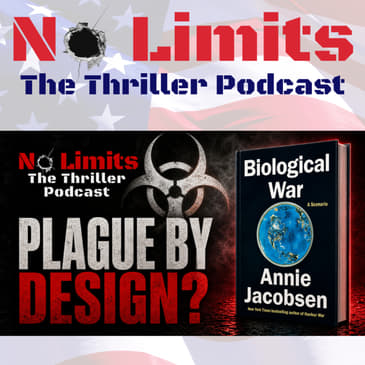
Biological War: A Scenario by Annie Jacobsen is the subject of this spoiler book review from No Limits: The Thriller Podcast. Chris and Mike break down Jacobsen’s terrifying nonfiction scenario about an engineered biological weapon, a fast-moving plague, and the systems meant to stop a global catastrophe.
How does Biological War compare with Nuclear War: A Scenario? Does Annie Jacobsen successfully combine deeply researched journalism with the propulsive pacing of a thriller—or does the book’s apocalyptic vision become too bleak to feel believable?
—
🔗 WATCH, LISTEN, & FOLLOW US:
Website → https://thrillerpod.com
YouTube → https://thrillerpod.com/youtube
Spotify → https://thrillerpod.com/spotify
Apple Podcasts → https://www.thrillerpod.com/apple
Instagram → https://thrillerpod.com/instagram
Twitter/X → https://thrillerpod.com/twitter
Facebook → https://thrillerpod.com/facebook
💬 JOIN OUR BOOK CLUB
Die-hard thriller fan? Join our Book Club on Patreon for exclusive discussions, behind-the-scenes insights, and 24/7 thriller conversation:
👉 https://thrillerpod.com/bookclub
📚 ABOUT NO LIMITS:
• The Mitch Rapp Podcast: Deep dives into Vince Flynn & Kyle Mills' Mitch Rapp series.
• The Scot Harvath Podcast: Exploring Brad Thor's high-octane Scot Harvath universe.
• The Thriller Podcast: Book reviews across the thriller genre: Jack Carr, Dan Brown, and more!
—
#AnnieJacobsen #BiologicalWar #ThrillerPod #ThrillerBookReview
[00:00:11] Hey guys, I'm Chris. And I'm Mike. And welcome back to this week's No Limits: The Thriller Podcast. What's new this week, Mike? Well, I thought we were the end of the world podcast. Seems like it. I don't know. Are we desensitized after having read all these thriller novels to the bombastic crazy scenarios that just might take us all down? I feel like we've seen it all reading these books. Yeah, it's an interesting change of pace.
[00:00:41] And sort of, I don't know, test to one's senses after, you know, we're like we just did by a nuclear war. And, you know, how many books have we read that nuclear war is what's going to happen? But I do feel like here. We go both in this book, Biological War and the previous one, it does go a little bit step further, more so than one, a lot of the acts that the stuff actually happens.
[00:01:11] Whereas, typically, it's our hero that saves the day, right? So, we never truly see what actually happens. But... Yeah, I feel like there's bits and pieces of these stories that, like, hinted at a typical thriller storyline we'd have. Particularly in this one, Skid Row. I think the Skid Row stuff was like straight out of like a crime investigation kind of thriller scene.
[00:01:35] So, yeah, the stuff she's imagining and making up is like on par with some of the best writers we've ever read and the crazy things they come up with. But what I liked about this one is it seemed to address almost every critique. I guess we should say we're covering Annie Jacobsen's newest book came out this year, Biological War, A Scenario. With spoilers?
[00:01:59] Yes. A direct follow-up to our last pod where we covered, or I don't know when you're going to publish this, but we covered Nuclear War, A Scenario, the book that came out two years ago. Yeah. And guys, if you go back and listen, I had a few critiques on that book. It's interesting. We're going to... I think you and I might have different takes on which book, you know, is the better of the two. But I had a number of critiques, and I do feel like each one of them was addressed here.
[00:02:22] It almost was like her and I were in conversation the way she wrote some lines that were things I explicitly said I wish the first book had done. She leaned into the interviews. She definitely quoted a lot more experts and people that she had access to. She gave more history lessons. I think the history lesson chapters in this were some of my favorite. And then at the end, she even addressed, this is just a scenario. It's one of many possible scenarios.
[00:02:50] So I think there were a lot of things in this book that raised the bar, just made it even better, a more enjoyable read. For some reason to me, a heck of a lot more scary. Did you feel the same way? Um, no. Really? And I guess because... Well, at times I was more scared in this novel, but I was way more scared throughout the entire thing in Nuclear War.
[00:03:15] And I don't know if that's just because of how devastating and how immediate that is. Um, I don't know if part of it is how desensitized I am to, you know, I, I, sure it's scary, but I deal with like this kind of stuff all the time and, uh, you know, work with micro... I don't work with dangerous microbes, but I do work with microbes and, you know, understand the...
[00:03:39] I guess I just have a more, uh, hopeful view that we would, that this is less likely to happen than, you know, nuclear war. But even in this one, she, she brings up the whole nuclear aspect of it in the sense that we can potentially, uh, you know, undo what we, what we've done biologically. But can we actually undo what we've done nuclearly?
[00:04:02] Like, you know, go, even going into that, what she didn't touch in Nuclear War is that, that site in, the Pantex site in, in Texas where, you know, we have these nuclear cores that were, you know, they're, yes, they're dismantled, but it's still there. And you don't even think about, and I feel like this book did, did a lot better than some normal post-apocalyptic, you know, when you think about, um, uh, what's that show? Um, The Walking Dead.
[00:04:31] Like, once you have people stop working at nuclear reactors, like, that's, the show just like the, you know, it, no one would, the zombies would die, you know? When you think about that, and I, that's something that I've never actually thought about. Well, I felt the same way about, definitely nuclear reactors are the most scary, but I felt the same way about a whole bunch of other government positions or public safety positions. Mm-hmm. And how many of those employees just have no incentive to do the job, right?
[00:04:59] When things are getting this bad, it's every man for himself. And the government, in their plans, has to, like, dangle antibiotics and vaccines, like, being allotted for certain, I guess you would call them essential government workers. And that might be the only reason they have to show up and do that job or fill that position. So, I found that really interesting, this almost apathy that, you know, it very quickly, very quickly becomes every man for himself, it's game over, cat's out of the bag. Even with the president, right?
[00:05:29] Not that they're giving up on all these bunkers and all these plans, but they have a point at which they just go into hiding mode, right? They just shove them away in a small suburb somewhere. By himself. Nobody will know. By himself, just connected to the internet, the only one who can use it, and to run the country just hiding out. It's like, we're beyond bunkers and all these doomsday preparations. We have to go to plan, like, X right now.
[00:05:53] And to think factored into that is all of the systems we rely on for survival and for society to function, nobody has an incentive to do those things. They only have an incentive to protect themselves and their family. What are you going to do? Yeah, and like, just thinking back to what we learned in nuclear war, right?
[00:06:13] Once, even if people were to survive, you have, like, all these second order things that are going to go awry because of the lack of human bodies. And so, here, you have people not showing up to work in nuclear reactors, not showing up to work at wastewater sites, at dams, which, you know, will ultimately overflow, cause catastrophic flooding. Like, you have, you know, just crazy stuff to think about.
[00:06:42] And I guess the other crazy thing about this novel is, like, thinking about the interplay of how quickly something like this can escalate, you know? And I guess that's what makes, like, the whole bioterrorism aspect of it, like, the mutation aspect of it. Because you can sort of break this into two parts, right? Like, what if COVID was worse than it was in, like, a naturally occurring pandemic versus, like, here you have, all right, it's whatever's going to happen.
[00:07:12] But then you ratchet up because of the sadistic minds of these, you know, whoever's building this, whether it be us, whether it be the Soviets. All right, just, it's an interesting mind experiment to try. No, you're right. But I think that's almost what makes it more scary. Because I'm not going to deny the nuclear war scenario she laid out is humanity's dead. Like, the Earth is essentially dead. Like, it's over. Life on Earth, whatever form that takes, centuries and millennia into the future,
[00:07:41] is going to look way different and probably not involve our consciousness. So, yeah, like, I feel like nuclear war hit on that level of it's just crazy, batshit, world-ending insane. Something about this one is scary, even though it's like we've had the Black Death, right? You know, pre-scientific times, we've had a third up to a half of Europe wiped out. And we recovered, right? Civilization continued. Humanity continued. We've had other pandemics and things.
[00:08:07] So, whether it's weaponized, whether it's natural, I feel like this one's almost more scary in that it forces you to think, what does life after this look like? What does getting those systems back online look like? What does it look like when all of our satellites have crashed, you know, because nobody took care of them? Maybe we save the nuclear reactors, perhaps. But just there will be a humanity, but how many people? How will they reproduce? Who will they be? Where will they be?
[00:08:33] And what does it mean for our psychology to now shift into this mindset of you can't be near people? The social aspects of humans is gone for survival's sake because the few remaining are the ones who were so isolated. So, now the human species as a thing is no longer this social animal that tens of thousands of years of civilization have created. That's a scary prospect for me, the fact that we are still alive and the planet will still have something. But what is that something?
[00:09:01] Where nuclear war, it's like, ah, it's all radiation crazy. The last remaining people got like three legs, whatever. You know, like it's just kind of insane. Like off the charts insane. Like when we started flinging nukes, like what's the difference between like four nuclear attacks and then all of a sudden Russia losses 50? And then we launched 2000. And like to me, that just gets bombastic and crazy. We're here, this slow seeping of the thing. And by the time you realize you got it, everyone's already dead.
[00:09:28] Or by the time you realize you were infected, you took the antibiotics, which is now going to trigger the chimera release, which screws you even more. Or maybe you're in the euphoria stage. This one is hitting on a different psychological level for me that is infinitely more scary. And perhaps because I know so little about the microbiome of Earth and humans and what goes on in our system and how these things spread.
[00:09:50] But knowing what I know from COVID, how something with whoever you ask, you know, a 0.1 lethality rate or whatever, how much that screwed us all up as a society and led to distrust and the collapse of many American institutions. COVID is like little c COVID. What happens when it's like capital C COVID or capital P plague? Like knowing what we know from the last six years, I'm scared out of my boots about that.
[00:10:17] Yeah, I guess the scarier thing, right, is that you're going to either you're going to be one of the first ones that gets sick and die or you're going to have to suffer through whatever remains. Whereas in nuclear war, you know, that entire book takes takes the place over what, like 50 minutes, right? An hour and 20 minutes. Yeah, 72 minutes or something. Yeah, like something like maybe an hour and a half. So most of the people are asleep before they even realize like, you know, or they die peacefully. Yeah.
[00:10:46] I mean, besides the ones that like, you know, it'll be very quick. Whereas here you're going to see the devolution of society. Right. I thought one thing that was interesting that she didn't go into was how this would impact. You know, she really focused on the United States. There was like a skosh mentioning of like what happened in Russia and how like they simply screwed themselves because they rushed out this unproven thing. Right. Right. But to me, right. If this got out.
[00:11:16] Then. It's getting out everywhere. Like you as soon as like someone got into the like the whole world is is happening like like. But I guess she just decided to focus this one on the United States. I don't know. I think it was the fact that Russia had all of these experimental vaccines. If that's indeed what they were, I guess, gene therapy type of solutions that weren't solutions. Well, it was probably just something issues. Yeah. I don't know. I found that interesting.
[00:11:43] I was like, what does a society look like when they have an entire generation of no children that are I don't want to use the term normal, but like no children that are, you know, their full potential as humans, but who have genetic deficiencies. And that's not just like a subset of the population. That's the population. Like, yeah. What's that going to look like in 30 years? Right. Yes. I wonder. So I like that you use that as like a small, small example.
[00:12:10] It's not like one of the leading things in the book, but it's one of those small ones that really got me thinking at least. The other question I had is, do you think society would break that fast? Absolutely. You have people in L.A. that. Absolutely. Like people like why were the people in L.A. so mad? Because they thought that these homeless people were tweaking and then all of a sudden you have a thousand people dead on the streets like.
[00:12:38] Dude, when those corpses are lying there and you're getting the early pictures, like she said, you know, people showing up on just like skateboards and taking videos because they're banning the actual media. So like you're now getting information drips through those kind of channels and they're obviously going to make it clickbaity, make it worse than it sounds. So you're freaked out from that. And then you realize. The health because another part of this book is the health infrastructure is severely limited. The amount of beds there are, the amount of containment areas.
[00:13:06] Once this thing goes beyond like five people in a city, there's absolutely no hope of containing it. Like there's no hope. And so if you have all these people dead on Skid Row, how many hundreds or thousands of people did they give it to? And then you have emergency management systems that are just basically giving up.
[00:13:21] Once that's all realized, I think shit hits the fan so quickly and panic ensues and people are heading for the hills, just going out into the woods, trying to make a plan for themselves, which is Americans fighting Americans over scarce resources. I think that kind of stuff happens not in a matter of weeks, but in a matter of days. I mean, but here it happens in a matter of, you know, 12 hours or so. But maybe I'm just misreading her progression.
[00:13:50] It's because I guess you have to then think about like every 12 hours, this thing is doubling, right? You know, it's because you have one person infecting 40 people or at least 11 to 40 people, depending on like the proximity. Right. So. Yeah, it's just getting out of hand. Yeah. I mean, I thought she played that up real well. To me, that was some of the most suspenseful parts of this was that anticipation period of does everyone have it and we're screwed and we just don't know it yet?
[00:14:18] Or are we going to kind of be OK? It's kind of like with COVID when we all didn't know how long our jobs were shutting down for, how long the lockdown was like just two weeks on that. I remember telling my students, all right, they're going to clean the building up. See you in a week. Everybody go home. Stay healthy for a week. You know, like we all kind of kept stuff in my incubator thinking that I would be back like to be able to like work on it in two weeks, you know? And so we all have those stories. So that's actually something I wanted to ask you.
[00:14:49] Do you feel the fact that COVID happened? We all lived through a miniaturized version of this, thankfully, that that didn't become as bad as it could. Yes. It was very many looking back on it in the scope of the possibilities. It didn't feel that way to people who lost loved ones. So I'm not trying to downplay it for them. No, no, no, no. Not at all trying to downplay it. And I would say in the moment, people are pretty revisionist. And like we can look on it now because we know that COVID ultimately wasn't as bad as it could been.
[00:15:19] But when you're dealing with a novel, something novel, something new, that's the whole idea of it. You don't know, you know, like this, you know, COVID could have had an R-naught of three, like smallpox, right? Like what is it? An R-naught, average R-naught of seven. Right. So it's almost like, let's say this was a lab leak. And let's say there was gain of functions, a whole nother conversation to get into. For different purposes. Or they added something in to make it even more transmissible. Yeah, yeah, yeah. Right.
[00:15:48] But let's say something got out. We would want it to be COVID. Like looking at what Annie lays out in the book. I'm like, if this shit's going to happen and a weaponized thing is going to get out of one of these labs, please give me something as easy as COVID. So I'm not trying to downplay the impact it had on people's lives. But compared to what it could have been, this could have been really bad. So do you think this book was made better or more enjoyable as a read by the fact that we all had that experience? We've all kind of been through this. We kind of had a familiarity with it.
[00:16:18] For example, of reading nuclear war, if you're somebody who lived in Japan, had family members at the time, it makes it a whole different read, right? Whereas for us, we all are in those shoes now with biological war because we kind of had the mini version of it. So do you think the fact that we had COVID and Annie had COVID to reference and kind of have as this background substrata of the book, do you think that helped the book and helped its enjoyability as a reader? It's an interesting question.
[00:16:48] You know, I think if I had read this book in 2018, I would have been a lot more scared or a lot more scared. Really? I think, you know, it's something like this that George W. Bush read, like a version of this or about like, you know, the national stockpile and everything that scared the shit out of him that made him start, you know, thinking about some of this. I'll tell you one thing. If this book came out in 2021, I wouldn't want to read it. I would have.
[00:17:18] Oh, sure. No. During the COVID years, I would not like this would have been like, no, no, thank you. Sheldon, not happening. I'm kind of thinking if this came out before COVID, it might have had a similar response of it's almost too fantastical. Bioweapon engineering. Hearing the general public didn't know about Al Qaeda and that they actually had plans. And that woman, right?
[00:17:42] Siddiqui, you know, who was carrying plans of Al Qaeda's possible attacks of how they wanted to do something like this. Most of us didn't know about the Soviet era bio war programs being absorbed and continuing in the Russian Federation vector. Right. Something like a vector. So I feel like it would have had a little bit more of that fictional thriller acceptance where people would have maybe just kind of read it, shelved it and thought, oh, that's kind of a scary storyline like any other book I read.
[00:18:11] But after COVID, I think it hits even in a worse way because we saw how crazy we made ourselves with that one. And it wasn't even the real deal. Right. Right. Yeah. No, I understand that. Yeah. So I find it more scary. Thinking back to like, I ran out and bought a gun for the first time. Dude, made people do things. You had people, I remember the day I bought mine was like the guy was telling me, yeah, I had two soccer moms come in and buy 10 guns each, you know? Like. Yeah. And to think, to think we did that, you're right.
[00:18:39] To think we did that for what ultimately COVID was and this is how many times worse. Yeah. The things that really hit hard for me were this idea of we had this national strategic stockpile that has to be kept super secret because if not, as soon as it gets out, people are going to be swarming it.
[00:19:05] Then this idea that those are put aside for essential people and like who is an essential person and how do you make that list? And like, who is, are you okay with the people that are determining that list? Because there's even like a point where, I guess when they're talking about devolution, in the sense that one of the places they go to, there's going to have to be a choice of, all right, even the people that work there every day, all of them might not be essential because they need to bring in more people.
[00:19:34] They're going to send some of them out. That are more important than them. And they're going to be the ones that get the vaccines first. Imagine. Yeah. Even though I work for this institution, I set this up and I'm not going to be one of the chosen ones to be saved. That's what I was just thinking. Like, imagine you're a civil servant who your career has been readiness planning and you've stockpiled the gear. You've worked on the list. You've got the authorizations. You spend years of your life on this. It happens.
[00:20:04] Because, you know, you think they're going to lock the bunker door and you're in there. And like, I don't know if you made a plan for your family or whatever. You're like, I'm good. And then armed guys come up and like, oh, no, there was a deeper state. There was like a deeper plan than what you were planning for. And you're not included in it. Like, dude, that's crazy. There are some other crazy ones, too. Like the refugees. I almost wish we had more of that. Never thought about that. Never considered it.
[00:20:31] You know, the guy goes to Dominican Republic and it's on this island. People are leaving. What happens when you got like you got to bomb them, right? Like, I wish we got to see the level of government that the government responding to that and what interventions they may or may not have done. There's a brief conversation with like the Coast Guard and like who can take over the Coast Guard and the president transfers it from what is it? Homeland Security to Department of Defense. I guess that's because they want to play more hardball, right, for defending the borders.
[00:21:00] But I wanted to see that almost play out a little more because I find that very intriguing. And it was something I never thought about. The vulnerability of borders when it comes to a biological warfare. That was interesting. Yeah. Yeah. And she touches on where you'd have to, you know, the border, the demilitarized zone between North Korea and Korea. Korea, yeah. And I'm like that, you know, causes like they would be on heightened alert because those people, if they got it first, they would want to be coming over.
[00:21:29] And yeah, it's insane. And then the other morbid thing is even the people that do make it to, let's say, Underground Bunker, Mount Weather, the Colorado, whatever it was. Yeah, the Colorado thing was cool. She puts it in there that the reason bubonic plague was so bad was because it existed to live in rats and fleas that didn't contract it but didn't actually die.
[00:21:57] And so they're going to get in, you know, no matter how heavy your concrete walls, like rats are getting in and they might infect you in there. And I guess she does say to the very end, the only people that survive, that could survive are the ones that keep their mask on at all times, even while sleeping. It's not happening. Like, you know, I think the ones who survive are like the indigenous tribes in Borneo or, you know, Central Amazon or the Andaman Islands.
[00:22:25] So that was kind of my point before of like what happens when those groups are humanity, right? Like would they have the vocabulary? Would they have the knowledge to rebuild systems? Or would we be basically back in a Stone Age, a Bronze Age or whatever? That's crazy. That's the human species. And then the question, she kind of hinted at this with Gobekli Tepe at the end of last book in Turkey. Has this happened before? Has this happened before? Has a cataclysmic event. Was it the flood? Was it the younger driest impact?
[00:22:55] When was the last time humanity had like a reset? And how far advanced were we before that that we've lost? Yeah, we didn't actually touch much on that in the last part, but the Gobekli Tepe in the sense that I guess it's so weird. Or that area is so interesting is because it actually shows that we had these things like well before we ever thought we had these things, right? Exactly. Yeah. Well, that's the point, right? 10,000 years ago?
[00:23:22] We've traced civilization in the traditional sense, historians to whatever it is, 10,000 to 12,000 to 15,000 years ago, Indus River Valley civilizations, you know, et cetera, you know, that region. And so we thought that was the first time people did whatever, you know, use certain tools or did agriculture, the agricultural revolution.
[00:23:42] And so then you find something that's 20, 30, 40,000 years old that was also building large structures and having society organized, you know, in different ways. Does civilization go back older than we thought? You could even say the same with the Americas, right? There's this whole Clovis first idea that the Clovis people were the first ones to cross the land bridge and whatnot. And then that's being disproven. We find different artifacts like, wait, there were tools here that are predating by thousands of years.
[00:24:11] What we thought were the first people, first humans to cross the land bridge. So who was building tools and leaving them here in the Americas before that? Interesting. Or even different footprints and things that they're finding. So the White Sands is another one. I think we have history so wrong. So, so, so wrong. The archaeological record that we have should almost every time anything is published have an asterisk saying as far as we know or based on the evidence we know.
[00:24:40] Instead, I feel like we just purport to say if it's been published, if it's been from an academic institution, if it's been researched, that's the truth. Well, it's like, again, truth with a lowercase T truth insofar as we know it. But yeah, I mean, that's that's science, right? Like we come up with hypotheses, hypotheses. We do experiments that we suggest are proving us correct.
[00:25:08] And yet every couple of years you're like, oh, a new paper comes out and actually proves it's completely wrong. You know, or it, oh, it actually wasn't this. It was this, you know.
[00:25:18] And just knowing human systems and power and money and influence, how many people who had research, who had evidence, who dedicated their life to something have been silenced or, you know, disempowered, de-incentivized from going against the traditional narratives, threatening to lose your job, threatening, you know, lose your tenure or whatever.
[00:25:39] And so how many people have just not published or not pursued academic interests simply because of power structures that exist, you know, and or taking the easy route. So I feel like a lot of that is going on. That's a I'm glad you brought that up again, because, you know, that happens in Project Almere. Right. Exactly. Right. Right. Like he was he had this crazy idea that, you know, there can be life without water. And ultimately, like the the novel doesn't go into like, no, yes, it's true or not.
[00:26:08] But it is a very like he does have a point why, you know, we accept this thing as truth because that's the only thing we know. And, you know, every time something new comes up, it's the same thing, but that doesn't necessarily mean it has to be that way. You know, you know where else we've seen this. Where? Trust the experts. It's just something over the last six years that also involved biological, you know, issues. COVID. Like we've seen this during COVID. Look at the diary.
[00:26:39] Look at his journal. And he just goes up there and pleads the fifth. I'm not even going to say the name. We'll keep it moving. But that's my guy. This is dude. I mean, I'm just saying, like, what is truth? Pontius Pilate asked it. What is truth? It's a question. So you only know orders. You only know what you know, right? What do we know and how do we know we know it? There's a really good class, actually.
[00:27:07] And my school is an IB school, international baccalaureate. At the high school level in the diploma program, you have to take an epistemology course. I forget what it's called. Or it's like ways of knowing. Or it basically asks you, what are the modes in which humans are? Know things? What does it mean to say we know things?
[00:27:32] And it was within the last five to ten years, they updated that curriculum to include intuition as one of the capacities of knowing. You know, it's like scientific method, literature, arts, emotions, you know, all these different things. And they added intuition. And it was like very interesting to see that societies may be moving closer to this acceptance of something beyond. And I don't know where I'm going with that. But my point is, we only always know a slice of the truth.
[00:28:02] It happened with COVID. So if this biological war thing happens, everything, where do you even get the information from? We now live in a world. Who are you even going to trust when it comes out that how this plague works? What's safe with the plague? Take the antibiotics. Don't take the antibiotics. Take the antibiotics within 24 hours of contracting the disease. I don't know when I contracted the disease. Euphoric. I was in a really good mood. Does that mean I have the disease? Like, you don't even know who to trust anymore. Yeah.
[00:28:31] That's what's, like, really scary. I mean, we should talk about this whole Soviet biological warfare thing. And the vector. Vector of it all. Vector of it all. Yeah. You know, I guess I thought about, all right, we're probably, or we or someone's probably doing something like this. But then to have the interviews with these two defectors that were so high up and to get the firsthand testimony from them.
[00:29:00] Like, just that's scary. The fact that, all right, you know, it's sort of like up in the, oh, yeah, you know, they could do this. But then when you have someone like, yeah, we did do this. And this is how far we got. This is what we have. Like, to put a. And they were defecting. Some of them were defecting. Yeah, because of it. Yeah. To put a euphoric gene to then put in something that's antibacterially turned on to turn on a different disease. To make it like rabies. Crazy.
[00:29:30] It's wild. Also as crazy to get, I think it was vector, but one of the Russian labs that was doing this research to give them cover how they made it look like an insane asylum. So any intelligence agency flying over or with spies, they would see this lab disguised exactly like an insane asylum should look. People in straight jackets, people in yards doing zany things. That is just next level deception. That's straight out of the Americans.
[00:29:59] So speaking of the Americans. William, I don't know if you saw it or if you remember that season. They did a biological agent. It was mentioned in the book once. It was Glanders. And William is basically in the U.S. working on Glanders. I think he was at Fort Detrick. I don't want to say too much more. But there's a whole storyline about a Russian spy working on this disease, infiltrated our military and our BSL labs.
[00:30:29] I guess Detrick is what? The highest BSL for? Fort Detrick had, at the time, it had the only BSL-4 lab in the military. That's another thing. The first one. The way she's documenting the rise of these labs, how it's like we only had that one. Pre-9-11, that's what it was. And then Atlanta. But now it's like something like 15 of them in the country and then hundreds of BSL-3.
[00:30:54] Which is still dealing with plagues and I think they can even have, maybe not smallpox, but Ebola, anthrax. And we have thousands of those. Like, what? Like, they're not all secure. If you tell me there's one lab, okay, I'll maybe believe you can make this the most secure thing on Earth. You can Fort Knox the hell out of it. I don't even know if the gold is in Fort Knox. Bad analogy. But if you have like one of these, I would imagine you could protect it.
[00:31:20] Once the world has thousands of them, don't tell me these random countries and these random governments and all this corruption and what we know about spies. Anything is safe anymore. Nothing is safe. And this is just a fire, right? It's just a fire at Vector that starts the thing. Yeah, and he thinks that it's going to like burn what he does and it actually like explodes the windows. Trying to do the right thing. Trying to do the right thing and it causes, you know, everything. I love that in the first third of the book.
[00:31:49] The setup to get Vector. The setup for this is cool. I really love the setup. I think the middle part may be Wallos a little bit, almost a little too technical. But I think the drama of the first third of this book really getting the virus to the release point to patient zero and even the hunting trip, right? And how they're spreading, getting on airplanes. All of that I thought was fantastically done and at a higher level than nuclear war for me. Yeah, I like the cold open. Sure.
[00:32:17] We don't find out that he was on that hunting trip until much later, but, you know, he's just at a discotheque and we see like, I guess the whole first third of the book understanding how, you know, quickly these things can spread. And, you know, it's mentioned multiple times in the book. Once you're too late, like if it's already here, we're all dead. You know, like his time to act was to close the borders before he even knew that he needed to close the borders. Right. Right.
[00:32:47] Or the fact that, you know, the guy who ultimately puts the fire, he doesn't realize that he's sick. He goes to the confession. Yeah. Right behind him is this guy that then goes to L.A. Yeah. Who infects Skid Row. Those little vignettes were really, really well done. Yes. And then that's like Contagion. I think like to understand. Have you seen that movie? I haven't. No, you've referenced it. Yeah. I watched it like week one of COVID. It was a bad idea.
[00:33:15] Well, you mentioned for Nuclear War, we've got to watch the House of Dynamite movie. Yes. I feel like for this one, we might follow it up with. I don't know about that movie, but did you see the other one that some people were mentioning in the group chat? Thriller Pod Book Club group chat. Someone said there's another movie similar to Contagion. I didn't catch that. Yeah. They were talking about it. I don't know if I could scroll up and find it, but. Might be a good idea to also do.
[00:33:44] Let's see. Now you know movies better than I do. Yeah. I think just like Nuclear War, the one thing she does get, you know, that is correct in both these scenarios is the idea that clock is everything. And that. Sure. It's actually not that more people are going to get sick quick enough. It's that our hospitals are definitely going to fail the first.
[00:34:12] And because not only are they going to fail because we were way underprepared. You mentioned the whole there's only 100 ICU beds that could potentially treat people with that actually get real pneumonoplague. But then the idea that the nurses and the doctors are going to be the ones that get sick first in this biological weapon scenario. They're not going to show up for work. It's going to cause like more panic. And yeah.
[00:35:07] Yeah. Here, I don't have any hope that any sort of restructuring and making more beds and having more containment areas would end up stopping any of this. Like one guy on a plane. You're donezo. So, I mean. Yeah. No. And especially because of the way it was, you know, genetically modified to be that much more lethal.
[00:35:29] I think maybe if this is like regular bubonic plague that just happened to mutate and now it's, you know, maybe a little bit antibiotic resistance so we can't treat with it. Maybe we have a hope. But still, I don't know. This whole asymptomatic thing too. I think that's early on. That's what threw a lot of people with COVID because initially you hear about these things and it's like, if I'm fine, I'm fine. I'm going out. It doesn't matter. Once we learn that this is asymptomatic for an incubation period, three, five days, whatever it ended up being.
[00:35:59] That's what makes the transmissibility of one of these things really, really a lot more dangerous. So, whatever bioweapons somebody comes up with, they're absolutely doing the euphoria, the long incubation period, randomly having people be asymptomatic who can also be spreaders. See, that's another thing that scares me is what's going on in a China, a North Korean, a Russian lab right now to make these things with all the lessons learned from COVID.
[00:36:26] People are looking at COVID not to say, how can we make our health infrastructure better? Many people are looking at COVID and saying, how can we make an attack worse knowing what we know from this now? Well, there are the conspiracy theorists that believe that, you know, if you do believe the lab leak scenario and- Oh, conspiracy theorists for believing the lab leak scenario that is absolutely documented and that a lot of experts agree happened and the government lied about that one?
[00:36:52] In the sense that the lab leak was intentional by China to- Oh, gotcha. How mild, like even with this such a, you know, something that kills like 1% of the people, right? It was 0.1% of the people that get it. Yeah. You're saying it was a test run, yeah.
[00:37:15] People that have the conspiracy theory that COVID was just a test run to see if they were to release something like this, you know, two times worse, four times worse, five times worse. I think Annie made a point of that too, of the wet market stuff. Yeah. When she was mentioning the history of how that narrative has been used, what was it in the 90s about something? And then even before that, someone else used it. When she documented that a few times, I was like, wait, that's exactly what they told us about COVID.
[00:37:45] Meat being mishandled in a wet market with bats that were flying around shitting on people. Like, what? Like, wait a minute. They've used that playbook before. I feel like she put that in to make a point to say, hey, everybody, you might have got hoodwinked. Like, that's the same storybook that we've heard before.
[00:38:03] I was trying to pin down, like, her ideology or her political philosophy because, you know, there's times where she doesn't mention Trump's name, but she clearly, you know, says this scenario is set in our current time. And so she has him do some Trump things. She has him do some more presidential things that I don't think Trump would do.
[00:38:26] She clearly, you know, has some critique for Gavin Newsom in the sense of, like, you know, making fun of the governor. And Bass. You know, yeah. And Bass. Yeah. She throws some zingers at the L.A. She throws some zingers there. She throws some zingers at both sides. It's just very interesting. Like, she I think she's like pretty down the middle. Yeah. But it was just interesting how she was. You know, I didn't I couldn't quite understand what she believes about this. I agree. You couldn't pin her down.
[00:38:54] Similar thing happened on the Rogan interview. I didn't listen to the whole thing, but he did ask her about the Iran war. And she straight up was like, it's ridiculous. Like, it's she she made her thoughts known on that. So I think she's an independent thinker based on the conversation she's had, the wealth of knowledge and people and expertise that she's encountered. And so I kind of appreciate that about her, that she'll. Yeah, she'll call out people on both sides, it seems, at least in these stories and how she's doing. Yeah, I like that. Yeah, I appreciate that.
[00:39:23] So you don't have to just toe one party line and be a zealot. What did you think about the Sam Altman interview and bringing the whole A.I. aspect of it into it all? Yeah. One, it's crazy that she puts, you know, that people would immediately go to ChatGPT to figure out where the National Strategic Reserve is. And somehow Chad GPT would figure it out. Right. And that would cause panic. And then this other idea of, you know, how A.I. is just going to.
[00:39:54] One, it's already desensitized us to question everything that we see online. At least I do. You either have people that believe everything or the people that don't believe anything, you know. Right. It's so true. It's so true. We're one or the other. Yeah. I think the most scariest thing about A.I., and yes, it was handled in those ways. To me, it's how much it can empower an individual actor. Like, it was definitely brought up that nuclear war, right? You need a whole program.
[00:40:22] I do believe there are international watchdogs that can assess, are you able to enrich uranium? Do you have B-2 bombers, nuclear submarines? Do you have a launch mechanism? Is it intercontinental? Like, I think that can be monitored to some degree.
[00:40:35] Like you've said before with the access to pathogens and microbes and whatnot, I feel like A.I. can just help the individual or small scale actor now, you know, play God or reach such a higher tier that previously you thought could only be done in some high scale lab or with very, you know, precise equipment. I feel like A.I. is now going to be almost like your chat buddy to help you experiment with a biological war and a biological agent in your garage and help you get away with it.
[00:41:04] I feel like that is probably pretty plausible or just the science behind it all that A.I. can unlock for people. That makes it darn near impossible to track. Yeah. A.I. Am Pilgrim mentions this a little bit too in the sense that, you know, the villain in that book completely exploits not to, you know, I don't want to spoil that book, but like, you know, completely exploits the idea that medical supplies are easy to get off eBay.
[00:41:33] You know, like, it's like, yeah, you can order whole jeans now for under a thousand dollars. Right. And it's like, you know, in the eighties or nineties, let's say you want to build a bomb. You got to take out a library book. They're going to track your library request, right? Your library search terms, whatever. Then late nineties, early two thousands, like could see your internet searches. They know what you're looking up. You know, I feel like things are so much easier to hide. Now you've read books and seen movies. Go to five different Home Depots.
[00:42:01] Use cash, you know, don't get seen by security cameras, buy a bunch of fertilizer or whatever. And you're making a bomb somewhere. Whatever. FBI, don't worry. We're a thriller podcast. We listen to books. You don't got to worry about us. But now, like, imagine that with biological warfare capabilities and like getting these genes and access to, I don't know, DNA sequencing, whatever you need to get this done. I have no idea. But I just feel like that's all accessible right now. Yeah, it's super accessible.
[00:42:29] And it's almost like the, you know, she brings, I like the history of the biology of it. In the sense that, you know, when we first, when the guy first discovered recombinant DNA and the idea that you could move something from one into another and have it express. That people were up in arms about it. That, you know, they even had to have internal conversations about what are we doing? Like, you know, is this correct?
[00:42:55] Now with CRISPR and, you know, you can literally genetically engineer the baby you want to have, you know. Exactly. So you have to trust a lot of scientists. Do you think that's the third book? You also have to trust like scientists and engineers with nuclear stuff because, but is that so much harder to like move around?
[00:43:20] And you got to trust them when you get in an elevator, you climb a staircase, you go in a parking garage. Like we're trusting so many people that we might have no business trusting. I mean, I'm sure Otis is a good guy, but like, you know, whatever government agency inspects the elevators, the parking garages, our infrastructure, our bridges. Like we kind of just trust that all that's being done properly and we drive across the Verrazano Narrows anyway, you know. It's a social contract.
[00:43:48] And nobody's checked it in 50 years and they just signed the documents and they're lazy and the union don't care. You know, who knows? Like I'm sure they do their job and they're very diligent about it. But I'm saying we put a lot of trust in a lot of things that keep us alive. I don't know how much I'm trusting our medical response and emergency management systems at the moment. Yeah. I want to talk to you.
[00:44:16] I guess this kind of leads into the question. Okay. I'm sorry. Just while we were on CRISPR, I was going to say, is that possibly the third book? Because I almost wanted to go a little bit more into the gene editing and splicing and like how we have a potential to mess up the gene pool irrevocably. I would think with certain technologies that we have and how they're applied.
[00:44:38] Is there a possibility that something about a whole generation of babies that are, you know, check a box on a form and you don't know what the scientists put into, you know, the test tubes and upload into your genetic code. Is that a possibility to basically destroy humanity for the future? Is that, would that be of interest? I think that would be of interest. Yeah.
[00:45:01] No, I think like something that digs deeper into, you know, where we are with synthetic biology and how it impacts the world. Yeah. That would be interesting book to read. What happens if it's like a particle that rubs on your skin or lands on your tongue or you inhale through your nose and then slowly it's replicating all new cells to have some sort of gene editing built into it. And then, you know, a matter of months, a couple of years or whatever, your body just is different.
[00:45:30] Every cell in your body that replicated had this new thing and for better or for worse, you know, I don't know. That scares me. What was the question I wanted to ask you? I brought it up earlier. I texted it. Yeah. Sorry. I cut you off there. When you mentioned CRISPR, I was like, damn, I'm curious how CRISPR ends the human race. I hope it helps.
[00:45:58] I hope it solves a lot of diseases, brings a lot of relief to a lot of people and families and gene therapy can be amazing technology. But nuclear energy is also an amazing technology. You know, vaccines are also an amazing technology. And every one of those things can be used for good or for bad. We got to be careful with this CRISPR, too. Well, I think this ultimately comes back to the question I wanted to ask you. And like the idea of this social contract, like what life is, right?
[00:46:24] This a social contract with various people, like pretty much every interaction is an implicit, you know, whatever. And this she goes into it a little bit with the reporters that get embedded into like one of those hunter gatherer tribes. Oh, right.
[00:46:43] And how, you know, are humans inherently predisposed to war to like fighting or are we predisposed to cooperation and being social or some sort of combination of both? That was a real interesting chapter. Yes. I like how she, towards the end of the book, gets very philosophical about these big ideas. A lot more than nuclear war. Oh, yes. She hinted on it at the end there. But here, I think it's just a little deeper.
[00:47:12] And it really comes down to your question of, you know, what is man? It's an anthropological question of like, how do you see human beings, what they are, and what's your, you know, belief system? Because, I mean, let's take the Western worldview, the Judeo-Christian worldview made in the image of God, right? Every human being is sacred, deserves dignity.
[00:47:40] How do you square that with a world where the only way for the human race to survive necessitates you have to stop caring about the other person? If you care about the other person, we all die. You die with them, right? Like, the survival of the race will be some class of people, the warrior class, let's call them, deciding to protect themselves in their own. Is that a bad thing? Are they making an immoral choice? But what if it preserves the species? I mean, it's an age-old question. So, I think it really comes back to what's your worldview? What's your view on anthropology?
[00:48:10] What is man? Why are we here? And I don't think there's a right answer. I think there's a spectrum of answers. But there's something going on that we don't know yet, that we don't understand. We can't answer the question because we don't understand the question. No, exactly. It's a rhetorical question. Yeah. What do you think? Or how do you think she presents it in this book? I think it's a combination of both.
[00:48:36] You know, when it comes time to humans are inherently going to self-preserve. And sometimes it could be self-preservation is working with other people. You know, or sometimes self-preservation is killing that other person. Scarcity. Yeah. When they're scarcity. Scarcity of resource. Dude, deep questions. Can humans undo what they have done? I thought that was a good question.
[00:49:05] She explicitly said that, I think, a few times towards the end of the book. And that's kind of where she went on the tangent with decommissioning the nukes. Yeah. It's sort of like a combination of both. Like, both biology and, you know, all, whether or not AI, you could throw AI in there. Sure. Absolutely. Will, because we are inherently smart and curious and constantly trying to innovate and take us to that next advancement, will that ultimately lead to our downfall?
[00:49:33] Space net, the sky net, whatever it's called, you know? Sure. Sure. Man. I should go back to my philosophy test, uh, textbooks in college. Take those things out again. No, this is a, it's a cool book to like have a book club and then have a conversation about it. I think both of these books, like you can do the same thing, but, um, I think reading them both together, it's like a nice duality. Um, I agree.
[00:50:00] And then having just a conversation about extinction events and human life. That's why I'm glad she brought the two together with the decommissioning of the nukes, because I mean, it's not all that different from saying, can we scale back any of our biological war programs or any of these technologies we've made? I don't know if we can. I don't, I don't know if we need to. Then like the nuclear material is there forever. She made a point.
[00:50:28] And in the audio book retelling, which she does a really, really great job of her voice is phenomenal. She says that material is there forever. We, we like made something and have something that will be on this planet for as long as this planet is here, regardless of us, it's there. That's kind of crazy. Yeah. I liked her better in this one. I feel like maybe she's, she's the audio book narrator for all of her books.
[00:50:53] It's not like she got better, but I just, I thought that she delivered this one a little bit better, but she is a very good audio book reader. Yeah. I just thought this one did a better job of bouncing between history lesson. Like I loved when a chapter started with history lesson and then there were clearly the fictional chapters that for me this time read much more like a story. They were actually characters. They were making decisions. They were having dialogue and conversations.
[00:51:17] And the third aspect is I think she went a little deeper into addressing her research and the people she could talk to and what's classified, what's not classified, what conversations she had with people who were actually in the driver's seat, who during their time were making these decisions or are read in on something. I feel like she divulged a lot more of the process in that three pronged approach that I appreciated where nuclear were all three got muddied.
[00:51:42] And so like some of them seemed like half baked or half done because I wasn't sure if she's really citing research and a conversation where here was very clearly. I spoke with this person who spoke with a Russian who worked at vector or who worked at wherever and, you know, was working on these things. It was a lot more upfront about the process. And I think that made it a better read. I also thought that nuclear war had a lot more technicality to it.
[00:52:06] Maybe that's just inherently because the nuclear aspect of it all made it that she wanted to dive more into the research, not only technicality of the nuclear aspects, but then describing like all of these weapons systems, you know, like from the ICBMs to, you know, the satellites and all that. Whereas here, she also did a lot of description of, you know, the various layers of government here.
[00:52:31] I feel like I felt better knowledgeable going into this one because I'd already read that one, you know, but if you were to just read this by itself, she, she kind of toned that back a little bit and, you know, just touched on like a little bit of it really, really putting you more in, in those settings where this is fictional. I'm going to put you in that a lot more than this book. Yeah. Yeah.
[00:52:53] I don't know if it relates to that, but it almost just felt more natural too, because I felt in nuclear war, this was a scenario, one way it could happen. And there were too many moments for me to say, no, we could have stopped there. No, this country didn't have to respond that way. No, the intelligence gathering or cooperation could have been shared. People could have used diplomacy. And like she rejected that outright. Whereas here, that's not even an option on the table. If someone's infected, they go on a plane, everyone's getting infected. Like she can make up the story of where it is.
[00:53:24] Dominican Republic. She can make up the story of the hunting expedition. She can make up the skid row in LA, but you're not just making that up. That that's how it's going to happen. Maybe not in that time and place, but that's inevitable to me where nuclear war. I felt like did not need to be inevitable yet. She wrote it as if this is inevitable. This is happening. All these policies mean we're just launching 150 nukes. Push a button done. You know, this one, I feel like the inevitability was so much more ever present where the nuclear war one, there were a lot of times where I could have said like, wait, maybe not.
[00:53:53] Or wait, couldn't we? Or wait, maybe someone would. Or did it have to? Do we just have to release a Chinese EMP for no reason? Because it seemed cool to add to the story. You know, this one's like, I guess you could say, do we have to have the chimera? Did we have to have the antibiotic resistance? Do we have to have the euphoria? But I felt like all that was done in a way that says, I'm making that stuff up, but this could, this is very plausible. It was a slightly different approach. And I feel like it was a more grounded approach this time. That's a good point.
[00:54:21] So you would argue that this book is better than the first one? To me, yes. Yeah. I think it's better too, but not for the same reasons. Like, I think it's crafted better. I liked the crafting, you know, some of the things we mentioned about going into a little bit more of the minutiae of certain things here. But yeah. Would you say nuclear war, though, was more captivating to you as a reader? Sure. Okay.
[00:54:51] Yeah. They both had like their pluses and minuses, but yeah. Yeah, it's true. It's true. Two very good books. Let's just put it that way. Yes. Two excellent reads I would recommend to almost anybody interested in geopolitics, war gaming scenarios, just wants to be depressed. Yeah. Talk about what was crazy. Talking about this idea of, you know, the quarantine, like, and how, when does that,
[00:55:16] when does public public health policy become like national security policy like that? You know, military involvement. When do you close the borders? Bring the national guard. Yeah. When do you basically give up, right? You don't go into LA and send health officials and send FEMA and send law enforcement. It's just, you're kind of like, yeah, LA's done. It's toast. You're on your own. Woof. What was the other thing? Ah, good book. All right. Your favorite part. What do you got to say? Because we can't scorecard this one.
[00:55:46] So what's a winner? To me, I think highlighting some of the things with government tracking and how, like, the minutiae there, I really loved learning about. Like, the idea that we don't take into account anything from, like, homeless encampments and, like, the large population that is there. You know, that's one of the crazy things about this is because it does go to skid row immediately,
[00:56:16] then that is inevitably going to pop off. Of learning about that we have these sensors embedded, you know, throughout the world. Like. We're listening. Yeah. You know, she talks about the eyes, the ears. Yeah. You know. And now you have all these, you know, sense, smells, like heat. What kind of intelligence was that called? I forget the name of it, but yeah, the way it was talking about those signals that were,
[00:56:46] we were picking up from everywhere and, like, which U.S. agency, which of our intelligence agencies were responsible for those signals and then how and when they share their data. I did like that deep dive as well. Yeah, that was real interesting. I knew we had, like, a lot of underwater systems. Like, we're detecting different vibrations from submarines going near cables and all things like that. I heard we're pretty, pretty good with that. But can you imagine, like, how many places we have bugs that in a traditional sense we think are, like, listening devices?
[00:57:15] Like, very Soviet era kind of, you know, bugs. But no, the bug might be, like, humidity sensors to know, like, what kind of research they're doing inside a lab or some other, like, data point. Like, we're collecting all of that and sifting through it. And now imagine supercomputers sifting through that. Yeah, like, they're able to know that the lab leak actually, like, they're scared about the lab leak because they're able to sense in the air these chemicals that mean that they're doing a deep clean.
[00:57:43] And they're like, oh, shit, we need to do a deep clean. Like, I knew we had, like, going into D.C., something would pick up, like, signatures of, like, radioactive stuff. Yeah, radiation, like, that kind of stuff. Yeah. Like, I knew about that, but the other stuff, being able to, like, sense in the environment different microbes, different chemical signatures, heat, you know? Not to mention our personnel. Like, we had that custodian guy at the... Oh, yeah. And then ultimately, human is... Human, yeah.
[00:58:12] The CIA is the most important because you can only know so much until you know what their true meaning behind it is. So that might be my winner because I hadn't thought of it earlier in our conversation. I was so captivated early on when we were in the war room receiving the SIGINT. Then they have to talk to the guy who's running the agent on the human and, like, actually contact him and the risk it is to his life for us to make contact and put those two together
[00:58:41] and then decide, do we elevate this to the president? And what channels do we put this through? That was also very well done in nuclear war. And I feel like that was also well done here again. So that's a hallmark of the books to me is how we get the information, who are the boots on the ground, analyzing the information, and are they going to and will the system be designed to direct it to the right people at the right time? That was phenomenally well done in both books. So on top of that, because it's related, it's just vector.
[00:59:10] Any time in this book she mentioned vector, I was just more interested. Like, I heard that in the audiobook and I was just like, I'm tuning in a little extra here, whether it was the actual fire going on in her story or when she's referencing the 2019 fire, how she actually based her story on historically a real fire that happened at this lab. Even the lab leak that accidentally happened at vector where the guy accidentally poked himself with the weapon he was working on.
[00:59:39] And he ultimately died and he died taking notes the entire time. So they could, you know, he, his mission could live on and they could get an understanding about how effective his weapon was. William in the Americans. That's all I'm going to say for those of you who know, I haven't watched that show at all. Dude. Oh my God. I'm talking about just this one scene, but there's one scene of many phenomenal scenes, but the people who know Glanders and William, it's like that exact thing that you were describing
[01:00:09] in vector and it, the show runners just got it right. They just, the writers just got it right. As many say about everything they got right in the cold war espionage game. So dude, got to get on it. All right. Maybe we can have a four done with books. We can have an Americans rewatchables. Yeah. Well, what's next? I mean, September, we've got the new Mitch Rapp book coming out. So the people are pressuring us to get into some dungeon crawler, Carl. So we'll see when that gets on the schedule and the gray man.
[01:00:39] We've got to get back to the gray man. So we got a lot to do on the podcast next few months. Yes, we do. And we got to record the fourth option with Tyler. We've been promising. We've been promising. Oh yeah. Got to do that too. A lot of books. All right. Before we get out of here, let me think. Oh, we didn't even. Sorry. One more thing. Let's go back. The cover. Oh, I know. I love this cover.
[01:01:07] It's a Petri dish that has like the globe in it or like the world. But then you have these little microbes that are growing to show like, you know, the equivalent of like an infection coming out. It's like a, it's a cool take on something we've seen with other biological war. Yeah. With the hotspots. Yeah. I just like the black background. The bright blue glow. The dark black background. Instead of red.
[01:01:36] I feel like red would be too on the nose. Yellow for all the hotspots. I think is interesting. Dominican Republic right there in the center. I do like that touch. Yeah. Yeah. It's a cool cover. Good cover. Good cover. I think my favorite thing about it is the colors. The light yellow, the black and the blue. Blue. Ocean blue. Did you see the other one? No, I didn't know there was another one. Yeah. I mean, I'm just finding in Google, but there's a, I'm in a gas mask. I don't know who, let's see if we can get more detail on it.
[01:02:10] A gas mask. I don't see any other. Oh, it is an American flag on the helmet with a red cross logo. So it's like total kitted up. It looks like the Australian version. I'm at least seeing this on a.au.com.au website. Yeah. I see it now. You see that now? Yeah. Kind of cool. Oh, I like that. The gas mask. Yeah. It's two different takes, but probably the right two takes. Yeah.
[01:02:39] Something about the pandemic spreading and something about the response and the gear. Yeah. All right. Before we get out of here, we need to thank our patrons, our deputy director, Sherry F, Brad E, Crowley C, and Michael M. Our special agents, Adam, Mike, Ben, Daryl, George, Matt, Don, and Chris. Please subscribe and rate and review all three seasons, no limits. Find us at thrillerpod.com. Or on Twitter and Instagram, at thrillerpodcast.
[01:03:07] And as always, just let Annie be Annie.