
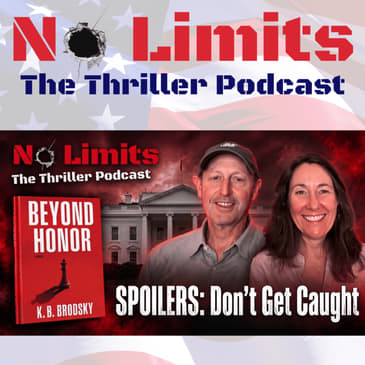
POILER WARNING: This full-spoiler interview with husband-and-wife co-authors K.B. Brodsky contains major spoilers for Beyond Honor.
We discuss the biggest twists in Beyond Honor, its high-stakes “don’t get caught” tension, the emotional pull of “only I can save him,” and what it is like to write a thriller together as married co-authors.
If you have finished Beyond Honor, join us for an in-depth conversation about its characters, suspense, motivations, pivotal choices, and the moments we can finally discuss openly. We also explore the writing process behind the book, co-author collaboration, and how the team builds a thriller in which danger, trust, and survival are constantly in question.
—
🔗 WATCH, LISTEN, & FOLLOW US:
Website → https://thrillerpod.com
YouTube → https://thrillerpod.com/youtube
Spotify → https://thrillerpod.com/spotify
Apple Podcasts → https://www.thrillerpod.com/apple
Instagram → https://thrillerpod.com/instagram
Twitter/X → https://thrillerpod.com/twitter
Facebook → https://thrillerpod.com/facebook
💬 JOIN OUR BOOK CLUB
Die-hard thriller fan? Join our Book Club on Patreon for exclusive discussions, behind-the-scenes insights, and 24/7 thriller conversation:
👉 https://thrillerpod.com/bookclub
📚 ABOUT NO LIMITS:
• The Mitch Rapp Podcast: Deep dives into Vince Flynn & Kyle Mills' Mitch Rapp series.
• The Scot Harvath Podcast: Exploring Brad Thor's high-octane Scot Harvath universe.
• The Thriller Podcast: Book reviews across the thriller genre: Jack Carr, Dan Brown, and more!
—
#KBBrodsky #BeyondHonor #ThrillerPod #ThrillerBookReview
[00:00:10] All right, we're back with Chris and Mike, K.B. Brodsky, the team behind Beyond Honor. And this time we are finally getting to spill the beans, talk spoilers. So just tell me, don't get caught, checkmate, or cigarette? Which was your favorite line to write in the book? Oh, wait, don't get caught. Oh, well, checkmate like mat. Yeah. Who's the genius behind those?
[00:00:36] Yeah, I think, well, the mod at the end was Karen when we were trying to figure out what to do. And then she came up with this idea that, you know, Pestova walks through the funeral and hands Cynthia King that letter or that picture. And I was like, oh, that's awesome. That's such a fun idea. Right. And then I was a little nervous that it was a little too kitschy, but it really seemed to like land. Yeah.
[00:01:02] After what she pulled in the president's ear in the back room, between that and then the folder drop, it was the one to punch that puts her up there. Right. She's fun. A badass. Yeah. Yeah. And by the way, I do, I don't know if you should say this about your own book, but I do love when the, the, the, the, um, the aisle guy hands to Cynthia King, the folder, and she's like, yeah, get out of here. Thank you for your folder.
[00:01:31] Yeah. Some of the little quips are great. The comedic timing of it all, you know, each of these books we've read in thrillers, it has heavy stuff. It needs a little bit of that comedic relief and you get it with little side quips like that. So brilliantly timed. Oh, thanks for saying that. Yeah. Thanks for saying that after he said it. After he gave himself the compliment. I know. I guess you know, I suppose we do that. What else do we like about our book?
[00:01:56] Well, I gotta say, we talked about it last time. I brought up this Faulkner quote of the human heart and conflict with itself. Who is going through the bigger internal struggle on their arc? Is it Kevin, you know, falling from grace? And it sounds like when he, when he takes those shots and he's a fugitive comes into his mind, he starts the book as America's darling, you know, back country guide, family, man, goes into the military, larger than life.
[00:02:23] And he's a hero getting, you know, getting, you know, all the, the metals pinned on his chest deserves this recognition. And in the end, he's on the lam, he's on the run. And, and even more than being, you know, running from the law, it's almost like he has to run from himself and the evil that is, is creeping into him. And I don't know, it just, it kind of hurt that that happened to Kevin.
[00:02:45] Do you guys feel the same way? Yeah. He gets justice. The justice is good and deserved, but it's good and deserved, but it comes with such a price, you know, it's good. Like, I don't think he ever looks back and regrets it. That guy's dead because he should be like just, and by the end, he's just such a puddle of loserness. You know, it's like, you don't even care, but, but he paid such a price for that. And so you do, because you want him. Yeah. I really want him to be okay. You know, he's pushed everything down and pushed everything down.
[00:03:15] He tried to stay so strong and then he just like loses it. And that's a hard thing. It's hard to see in yourself when you do something and you're like, oh shit, I didn't think I was the person who's, to be cursed on this. I didn't think I was going to be the kind of person who did that. I think he has that moment.
[00:03:28] And actually, I think that Whitney's fall. I think her fall from grace is more emotional and, and more deep because, you know, I believe that she betrayed Kevin's trust and really regrets it, you know, not just very quickly after it happened, but like at that second or the last third of the book, she's in some type, like, she's just regrets all these different moments.
[00:03:57] And when they finally see each other in that apartment, she's like, uh, you know, like, don't go. I, you know, like, uh, I, I, I think that she, her, her downfall is equally, um, devastating. I think. Can I ask you a question? Sure. Um, do you think that she betrayed Kevin?
[00:04:15] It couldn't be read that way. Um, I guess who were her primary allegiances and duty to, is it the boyfriend who they've really connected and they seem to have something there? Or is it her mentor who has, who has become, you know, the Cynthia King is becoming her mentor and her job and her country. Right.
[00:04:40] I, I, I don't think she should be forced to be put into the, you know, the mental gymnastics of if I tell him this and the op goes south and we, the CIA can't take advantage of, you know, running the game and playing him as an asset and using him and turning this to their advantage. That can't be square on her shoulders for kind of blowing that up if she decides to tell him, but she, she didn't. I, I, I think that's the moral gray zone.
[00:05:07] I think he's clearly, he's clearly going to see it as a betrayal and she's thinking of it as a betrayal, but objectively stepping back. It's like the, uh, what's that problem? The train problem, the trains going off the cliff, you could save the people. If you don't save the people, then you save a hundred more who are going to get hit by it. Right. Neither answer is right. It's the one you make in the moment.
[00:05:30] If you had the intention and a good heart in doing so, you probably made the best call that you could have with the information, but it's going to hurt. It's going to stay. Right. Yeah. But also she, she betrays, I think, I think that she betrays him for an operation that was a rogue operation to begin with because Cynthia King is pushing Summers to, to go in a direction. That's probably a little like definitely on the wrong side of right.
[00:05:57] And because Summers owes King an emotional debt. And so she's going off the rail, all these people are going off the rails. That was the, you know, the premise. King got a little unhinged in the church when she really pressure Skylar. Okay. What are you going to do about it? You're going to go out yourself. You can go in front of a committee and, and, and say you manipulated, you, you know, you lied to the president essentially, or you produced Intel. But she was also the mastermind. Stay closer to the mic. Right. That was intense.
[00:06:27] I feel like, again, like we talked about last interview, again, bombs are not being thrown. People are not being shot at, but there were shots fired in that church pew by Cynthia King. And to me, I was on the edge of my seat. Just is Skylar going to have a breakdown over this or Cynthia being the spy master she is? Is she manipulating Skylar to be more on her team, to be her crony, to do more of her dirty work in the future? Yeah. Is it all manipulation?
[00:06:53] When she says to Skylar, you have a seat at the grown-up table, now act like a grown-up, I think you're, you're pushing her button. Like, I guess I'm, I'm supposed to be okay with all this. Yeah. Right. And eventually, where does that lead Skylar to if, if she does follow that and Cynthia has this grip over her? Oh my God. I can't wait for you to read book two. I mean, people can be pushed to do things they never, ever thought they would see themselves doing. Yeah. Right. Yep. Exactly. Wow.
[00:07:21] And I think Summers, in hindsight, has said to herself, I can't believe I'm letting this happen. Right? Yeah, but the flashback brings us so much baggage and history of these two. Right. And cigarette is, is literally the, the, the smoking together in the office. Right. Is literally this like totem, this like symbol of there's so much more than meets the eye. These two, you know, old ladies at smoking room in the corner of CIA on the fifth floor, sixth floor, whatever floor they're up to.
[00:07:50] Um, but eventually seventh, I guess Summers up there. Right. Right. Um, the flashback. Like, did you know their story and their friendship and what they've been through? They've been through the ringer or did, did it kind of come to you as you, as you got there? I didn't know at the beginning. And it was, you know, this, this debt was building and it was, it took me some time.
[00:08:17] And the, the, the, the Berlin, I was, I was struggling. We were struggling with the time because, you know, the, the fall of the wall happened so long ago. So I didn't want these, you know, they were, they could, they could, they could be too old to be in their positions of power. Um, but once that kind of, that door opened up, it really opened up to so much fun stuff.
[00:08:41] Like we talked about in the last episode about, you know, the, the, the, the stick shift car, you know, I have an old 1981 Jeep CJ seven. And it's a stick shift. I was kind of like, you know, remembering how that, you know, like kind of how that, that car works and, and the, the old school, um, recording device and all that stuff.
[00:09:03] It was, uh, it really, I thought it was, um, it really helped, you know, the reader understand why Summers was doing what she was doing. Yeah. Why her hand was kind of forced that she wanted, she had to repay the debt to Cynthia. Yeah. She had no choice. But, and, and originally I took that as kind of this honest, these two women respect each other so much and love each other so much, you know, they'll go to hell for each other.
[00:09:32] And then slowly started eroding way of like, is this just Cynthia being even more manipulative? Yes. Yes. But her manipulation comes from such a place of believed integrity. Like she's doing this stuff, not for power. She's doing it because she thinks the end result is absolutely worth it. And it's the right thing to do. So country for her, right. For her, the ends justifies the means every time.
[00:09:58] And, and so that's, that's sort of like her guiding, uh, North star, whatever that you write about is, you know, she believes that she's not trying to do the wrong thing. So she's willing to like push Whitney to the edge or to manipulate Summers because she thinks, you know, saving Kamarov is, is like absolutely worth it or whatever the next thing is that she can do knowing that she has Vistova on the ropes. Well, cause she sees herself in Kamarov. She's Kamarov.
[00:10:25] And I think that helps bring the, the, you know, all that together so that you understand why she's pushing so hard. And the first chapter in the book, when we're learning that, that someone named Python was captured and she's in the corner smoking a cigarette with her cane. And she's saying something, you know, a little bit outrageous, you know, only I could save him. Yeah. That doesn't make any sense at the time, but by the second, third, you were like, oh, I get it now.
[00:10:54] The whole, this is all, you know, connected. Yeah. Nobody can imagine what it's like to be a POW. And so knowing that you have a possible, possible chance of getting somebody out of that situation you've been in. Right. You'll, you'll move heaven and earth, you know? So yeah. Yeah. The Kamarov of it all. Also an interesting backstory with the chess and his, his cover story in Russia. Not even.
[00:11:19] So your main characters, I could spend all day talking about how, how fantastic they are in their arcs. He doesn't even pop off really until the second half and really doesn't come alive until that kind of final third, that final act, the rescue scene. But at the same time, he's also that linchpin. These books, I'm just thinking like the web, like a beautiful mind of how everything connects. When we find out that he sees in the picture, the woman, the same woman who manipulated him. Yes.
[00:11:46] It is the one manipulating Michael and on stage with the president. There are a few of those moments that are such a joy to read. And it's rare in a book that everything works so well that you don't roll your eyes and go, that was a cheap move. You know, that was a cheap move. That's so, so kind of you to say. It landed. It landed. I would be the first one to say it. It landed when I was reading it completely. Well, that's, that's incredible to hear. Wow. That's incredible. Yeah. Now the stakeout scene, before we even get to that, I feel like a few things earlier on.
[00:12:16] And one of the things I almost was thinking in my mind, is it a little too staccato in the opening? You get the cold open in Alaska, but then I'm like, wait, that really taught us who Kevin Rhodes was. And then the through line is the R and R. He's wearing the gear, wearing the hat. So when he's downrange, we know how much of that is his identity. And it all came full circle when his father was the reason he wasn't on the Ukraine op. So even what I thought might've been this dangling open chapter, I was like,
[00:12:44] why were we hunting with him? I guess it proved his bona fides. But no, it was integral to the plot because we knew as a family man, he would not leave his team for anything except for his father. But for that. But for that. But for that. It's the one thing. And then that saved him. Right. Did you have this all planned out? Like, Bill, I know you wrote kind of the first draft. The most fun conversation we've had ever about this book. Yeah, this is incredible. How do you get there? Do you have this story boarded out from the get-go?
[00:13:11] I mean, Bill really wrote this general whole plot. But those moments that you're talking about, there would be a thing like all of a sudden we'd be walking and be like, oh my God, wait. Like everything you're saying actually was intentional, but it would come like, here's how, oh my God, this fits so nicely. Like these things would happen. Or one of us would just stumble upon a thing that helped pull these pieces together.
[00:13:36] So it wasn't all lined up, but the connections happened. And then it was like one of the most fun parts of writing the book. Would you think so? Yeah. So, you know, there was no outline for the book. You know, we, you know, it was written kind of from the beginning to the end. And then you had all these chapters and then, you know, it's almost like you could plant an Easter egg. And, and, and, or you could, you know, seed a story.
[00:14:06] The Comroff thing wasn't in that, written in a linear way. But, but I, but I, but I really feel as though all, all of this, because it's, you're building a little world and you only have so much time. And so you have to kind of link these things to, you know, and, and I think Clancy did that. Right. And, you know, this is, you know, you know, I,
[00:14:34] I've said this before Lee Childs, who was on one of these talk shows recently, he, you know, he was saying, there's no new ideas. There's no new plot. Everyone, you know, he ran, he shot, he came, a stranger came to town, all that stuff. And so, but, but he said, if you have something to say, something emotional to say, hey, you're going to capture the reader's attention. And, you know, that was our idea.
[00:14:57] So for example, the whole first Syria, Iran scene was okay. It was, it was perfectly fine. But the whole essence of it was for someone to say to Skylar, hey, you screwed up. Why don't you go next time? Do it yourself. Yeah. Do it yourself. Like if you're like, and so. Yeah. That got her into Syria in a believable way because she felt,
[00:15:23] you know, that, you know, she had failed them and she was trying to step it up. So, you know, like that was like all those little pebbles came in. Because that's exactly what my next thing was going to be. We, you know, we had the Iran op, we had the Syria stakeout. I was wondering how they all connect and they all connect through the characters, the journey the characters have to go on. Some authors just think like, oh, Iran's popping off. I want to put Iran in my book because it's hot. Ukraine's going on. I want to put Ukraine in my book because it's hot.
[00:15:51] But I really felt the intel the characters were getting and how the characters had to respond to the intel made that decision for you. Yes. He would also like, I would just say, start writing about something like put it in a place. It wouldn't even be a big thing in the news. And then all of a sudden after it's written, I'll be, I'll be like, dude, like what? It's like, it happened so many times. I bet book two and three, book two and three. I think you are probably writing things that. You have no idea how crazy book two. Can I say?
[00:16:21] Sure. I'm looking forward to that. Yeah. We're walking, taking a walk and Bill's like, I have this idea for book two. I think it should take place in Venezuela because nobody's talking about Venezuela. Nothing happens there. Nothing's been done there. So book two. When was this? Book two takes place in Venezuela. And all of a sudden it's like. Yes. Pre-invasion, right? Like you were talking about this last year. Yes. Wow. Yeah. Wow. Yeah. Well, it's wow and not wow because we're making some adjustments.
[00:16:50] We keep having to rewrite what's going on. Could even a thriller writer, I don't know if could have come up with America snatching a president of a country and his wife using these brain melting, you know, technology and power grids and whatnot. Yeah. We have a thing with Brad Thor. The joke is he calls it faction where the fact meets the fiction. Right. But I call it straight out, you know, like the straight out of series. And anytime something hits the news, I say straight out of this book, straight out of that book.
[00:17:20] And these thriller authors have just been on it. So we got to watch out for you guys. You guys. Can you just write a book about a booming economy? No unemployment. Yeah. Just AI doesn't try to kill us. Can someone write that book? Totally. Yes. The next thing is going to take place in a field and everyone's going to be holding hands. It's going to be really nice. Rainbows and unicorns, please. Yeah. Totally. Where we don't steal a dictator from a country and then all of a sudden we own their oil. But it wasn't for that reason. Now we're just making oil deals. It's all crazy.
[00:17:50] Yeah. Oh, it's complicated. How about the tech of it all? That's another angle. You guys have the glasses. And man, when the president is stomping those glasses in the residence, that was just to me symbolic of snapping at the highest level. When the leader of the free world, his finger can push the nuclear launch codes. And he's so frustrated by the betrayal of his friend and the position he's in. He's stomping. He's taking his frustration out on these things. Desperate. Yeah. Right. Wow.
[00:18:20] But the glasses, is this some tech you've considered? Have you talking to anybody about? I would be surprised if something with a bug can get past Secret Service. You know, do you want it? Oh, I'm being recorded. What made you come up with the glasses? I heard a story of someone walking into the White House who had a something.
[00:18:47] He had some surgery on his back and they placed bolts in his back. And he said he walked through the metal detector and it didn't go off. And he said to the Secret Service, he's like, hey, I'm in the White House. I just want to let you know I have metal in my back. Maybe your thing isn't working. Right. And the Secret Service was like, hey, why don't you walk through again? And it didn't come up. And so, you know, just, you know, you see, like, you know, pick a friend of the president
[00:19:16] who is going into the Oval Office all the time, who wears a watch, who wears glasses, who has a briefcase in absolute power when the president was killed by his friend because he had a cane with a knife in it. You know, like, you know, I think that it's probably less complicated than we think. You know, we do think about like how the, you know, the burst of like it has to happen in bursts so that they're not going to catch it like that.
[00:19:42] We tried to like make sure that it would, you know, thread the line between convenient but believable. Right. Right. Yeah. Because that is one of those areas where it could lead to an eye roll if you invent this as the young people say, super OP tech, this overpowering tech, which can just do all the things. And I feel like that's the scapegoat with AI. It was almost refreshing that AI was not very heavily mentioned in the book because I think it existed when we wrote it. Yeah.
[00:20:11] It's just exponentially growing in its capabilities. But I feel like some thriller authors have grappled with what to do with it and that it either becomes a crutch. You know, deus ex machina just gets you out of any situation. You just say it did the thing or the problem of once you put it in and it has these capabilities like the Jack Carr, I call it the Alice problem. Alice exists now. She's supposed to be this thing that can hear all things, do all things, direct, you
[00:20:37] know, kinetic tactical operations so that they go off without a hitch, collect any intel you ever want anywhere. Once you created that, how are you going to put it back in the bag? Like, right. Doesn't that have to show up every single time in every other book or the flip side? Once you blow up a city, once you have nuclear war, once you have some major attack, why would your next book or two books from now never reference it? That's a world changing event. Like September 11th, it's mentioned in so many stories because it changed the whole dynamic of how we think about safety and freedom.
[00:21:05] I feel like beyond honor, you've created and I said precision in the last interview, you've created a world that feels complex. It feels textured. It feels real. It's very gritty. The psychological profiles of people is kind of gritty, but it's also simple. It almost is a simple universe that doesn't get too unwieldy. You know, and something that, so we have obviously, you know, published book one.
[00:21:30] Emily Bessler is hopefully on the tail end of editing book two. And we have written the first draft of book three. And so we have tried very hard to keep the stakes in a place where you don't have the AI problem so that, you know, whatever Kevin Rhodes and Whitney is doing,
[00:21:57] it's not governed by big tech. And I'm finding it hard to escape, you know, to find a conflict, to find a problem that you could keep on a small scale where it does feel like it's high stakes without having the Superman problem. Right. You know, like he's laser eyes and cold breath and he could fly and he's like, he's bulletproof.
[00:22:21] So, and I think it's really a fun writing challenge to, to be in a geopolitical world where you are avoiding that problem. And I, and I'm hoping that if we could continue doing this, that, that remains so that we don't all of a sudden enter into like this all powerful, all knowing thing. That's gotta be tough.
[00:22:50] That that's the challenge of being an author. You gotta give us enough, but not too much. So I'm going to go off the rails a little bit with this question. Well, it makes me think how, like if we read, is that a warning? No, no, no. Go off the rails. I love, I love going off the rails. Go off the rails. Go off the rails. Tell me everything that happens in book two. No, no, no, no, no. This is more like a big, a crazy thing. When we're, say you're reading a book about the cold war or you say you're reading
[00:23:18] Le Carre and you're like, oh, this is so interesting. And I can relate to these characters, but, but some of this is not relevant to me anymore. And as I wonder how, as readers, we change reading books when it does feel like AI is going to be infiltrating sort of almost every aspect of our lives in so many ways. And you read a book that doesn't address it. I'm curious, like, do we, do we as human beings start to feel like that it isn't relevant
[00:23:45] or does the human condition sort of remain relevant to all this, no matter what's happening? That is a big question, but it just hit me. No, I think it's a big question. It's all how we relate to it, because you could hear these stories of like the pre-industrial age. It's like every, you know, the Luddites and everybody, this is going to be the end. This is the collapse. We must destroy it. I mean, we just kind of respond to it.
[00:24:13] And so how do you deal with AI now as just this tool, this, this thing we're going to have to learn to coexist and live with? It's like in schools. Your family knows about teaching. I know about teaching that the perennial problem of cheating with AI. Let's be honest. That's no different than in the past when calculators were first invented or somebody came up with a creative method to write on their arm or put a sheet of paper inside their pocket. There's going to be cheating is going to be the perennial thing. AI is just the next generation. That's going to make it harder to deal with and harder to respond to.
[00:24:41] But that just means we have to get more creative. So for thriller authors, I feel like you just have to get more creative. Yeah. That's the challenge. And we try to keep that technology in a box through our character, Sam Kim. So when one, when there's an obvious reason, you're like, Hey, can you hack into the phone? Can you hack into the system? Can you get into, you know, we have a guy, we got a guy, we got a guy.
[00:25:05] And it's like, it's all focused in this one spot so that the other characters can live outside that box. Yeah. It's kind of like, I mean, think cell phones. How many thrillers have we read, particularly growing up? Didn't even have cell phones. Right. And then to an author or someone in, you know, espionage, all of a sudden now there's cell phones. Like, yeah, we could send these messages. Well, but then there was the, then there was the NSA and the Patriot Act.
[00:25:32] So it's like what we thought was this thing, which is going to get around so many loopholes, secret communication. No one's listening. Well, then everyone started listening. So whatever the new thing is, there's going to be a response. And it's just, I think eventually going to even out and feel, feel so normal the way it's incorporated. There's been a couple of AI books. Mark Graney had a good one. I think the second or third most recent Gray Man, I feel dealt with AI and robots and, you know, tech moguls trying to take over the world. Oh, the one in that, the island in the Caribbean.
[00:26:00] I think it was Cuba or right off of Cuba. Exactly. Yeah. Yeah. Yeah. I feel like we're going to go through a wave of books that are that direct. We confront the robots, you know, we fight them. We have to deal with our AI overlords. And then eventually it's just going to fade into, it's always there. It's not the biggest deal. It helps us with things. It hurts us with things. And then there's something going on that is more about human connection and human relationships. And if an author can capture, that's where the drama is. The true stakes are like you did in Beyond Honor.
[00:26:27] I think that's so much more important than the tech specs, the whiz bang, the explosions and the nukes on the loose. I criticize books when there's just nukes on the loose. And that's the only reason I should care about what's going on. Right. Not enough to really get me interested. Right. Yeah. Good. I agree. I like that answer. Yeah. Thank you. I feel relieved. Yeah. Wow. Well, I was going to ask you just to wrap up the fishing trawler scene up in Newfoundland. And Kevin kind of, is he concealing his identity?
[00:26:56] Is he trying to get back? Is he trying to get into Europe, into Russia? I wasn't exactly sure where we're going with that. And I was kind of glad to not know where we're going with that. Right. But any hints? Can you clarify these murky waters a little bit? I think we could say it resolves itself very quickly in book two. Can I give another hint? I'm just saying like right when you read in book two, he's there. You understand what happened. That's my hint. Yeah. The bottle. Well, it's a bottle of something.
[00:27:26] It's a bottle of scotch. Single malt. All right. Okay. Okay. That's pre-order book two. Not available yet. I don't think so. But as soon as it is, we will drop that announcement on the pod and ask people to tune in. Because I think after a three-part series, enjoyed spending my time with you. Thank you for kicking it off with Chris. I cannot wait to have you on for book two. Will it be 2027? Is that the timeline right now? That's the plan. That's the plan. Yeah. Fantastic.
[00:27:56] Well, we're going to bug David about it until we get an answer. Do that. And we look forward to the cover reveal because that chess piece on the cover is phenomenal. I'm hoping book two. And like I said before, your book, your writing is about precision and simplicity, cutting through kind of the complex world we live in and getting to the heart of the matter, the true heart of the matter. I feel like your cover just keeps it simple. The two-tone, the red and the white is just stunning, clean, crisp.
[00:28:25] I would pick it up off a shelf if I saw it in Barnes & Noble. Oh, that's great to hear. That was, that's exactly what we wanted. Yeah. Well, this has been super fun. Thanks so much for being so, you know, complimentary. It's really great to talk about. Well, it's deserved. If it wasn't, I would be a Buzzkill. Hey, respect the Buzzkill. Right. Respect the Buzzkill. That's how we got to go. All right. Thanks for coming.